
AdrMcp
An MCP server that turns a folder of Markdown ADRs into live tools for AI agents: search, author, validate, link, and trace architectural decisions, with preview-by-default writes.
README

AdrMcp
<!-- portfolio-toc:start -->
Table of Contents
- Features
- The problem
- The solution
- Storage & format
- Tools
- Configuration
- Run
- Usage
- Claude skills
- Develop
- Continuous integration
- Project layout
- Tech Stack
- Roadmap
- Contributing
<!-- portfolio-toc:end -->
<!-- portfolio-getstarted:start -->
Getting Started
Prerequisites
Run
git clone https://github.com/Atypical-Consulting/AdrMcp.git
cd AdrMcp
dotnet restore
dotnet build
dotnet run --project AdrMcp/AdrMcp.csproj
<!-- portfolio-getstarted:end -->
<!-- mcp-name: io.github.Atypical-Consulting/adr-mcp -->
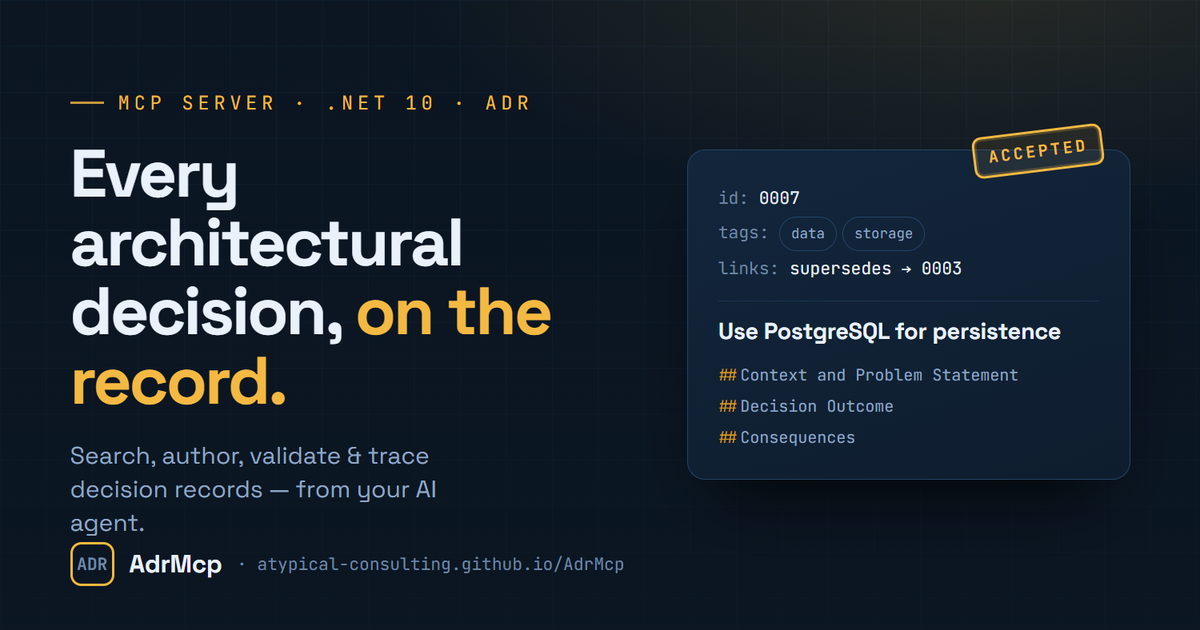
Every architectural decision, on the record — an MCP server that turns a folder of Markdown ADRs into live tools your AI agent can use: search, author, validate, link, and trace decisions.


🌐 atypical-consulting.github.io/AdrMcp
Features
- Read & search ADRs —
list_adrs,get_adr,search_adrs(lexical or semantic), andget_adr_indexfor the full decision timeline. - Author from a template —
create_adrdrafts MADR- or Nygard-format ADRs;update_adrreplaces or appends a single section. - Lifecycle-aware transitions —
set_statusenforces the ADR lifecycle;supersede_adrcreates the replacement and marks/links the old one superseded in a single call. - Relationship graph & staleness detection —
find_related_adrs/get_adr_graphexpose links and supersession chains;find_stale_adrsflags ADRs whosecode_refsno longer resolve in the codebase. - Conflict & coverage analysis —
detect_conflictssurfaces contradictory accepted decisions;coverage_reporthighlights ADR coverage gaps by architectural area. - Preview-by-default writes — every mutating tool defaults to
previewOnly: trueand returns a unified diff before anything touches disk. - Ships as a dotnet tool, NuGet package, and Docker image, plus three bundled Claude Code skills (
adr-author,adr-review,adr-supersede) for the judgment layer on top of the raw tools.
The problem
Architectural decisions get made in Slack threads, PR comments, and someone's head — then the
reasoning evaporates. Months later a teammate asks "why is it done this way?", nobody remembers, and
the decision gets silently re-litigated or accidentally reversed. ADRs fix that — if they're
written and kept honest. But a folder of Markdown files is inert: you can't ask it what's still
accepted, trace what superseded what, or notice a decision that no longer matches the code.
It's worse with AI coding agents: the one collaborator that could keep decisions current has no way to read, write, or reason about them.
The solution
AdrMcp makes that folder a live surface any MCP client can work. It gives your agent tools to list and search decisions, draft new ones from a MADR template, validate structure and links, supersede a decision while preserving its history, and flag stale or conflicting ones — all preview-by-default, so nothing is written without you seeing the diff.
The records stay plain Markdown in git; AdrMcp adds the tools. Built as a .NET 10 stdio MCP server,
architecturally modeled on RoselineMCP —
layered Tools → Services, [McpServerTool] attributes, shipped as a dotnet tool + Docker image.
Storage & format
ADRs are markdown files under an ADR root (default docs/adr/), one file per decision named
NNNN-kebab-title.md, using MADR 4.0 frontmatter + sections:
---
id: 1
title: Use PostgreSQL for persistence
status: accepted          # proposed | accepted | rejected | deprecated | superseded
date: 2026-07-08
tags: [data]
links:
  - { type: superseded-by, target: 5 }
code_refs:
  - { path: src/Data/Repository.cs, symbol: PostgresRepository }
---

# Use PostgreSQL for persistence

## Context and Problem Statement
...
## Decision Outcome
...
## Consequences
...
Everything is git-native, human-readable, and diff-able — no database.
Tools
| Tool | Kind | Description |
|---|---|---|
list_adrs |
read | List/filter ADRs (status, tag, date range) |
get_adr |
read | Get one ADR; optionally only selected ## sections |
search_adrs |
read | Lexical (default) or semantic term-vector search |
get_adr_index |
read | The decision log / timeline |
find_related_adrs |
read | Incoming/outgoing links + supersession chain |
get_adr_graph |
read | Full relationship graph (nodes + typed edges) |
create_adr |
write | Create an ADR from a template (madr or nygard) |
update_adr |
write | Replace/append a single ## section |
set_status |
write | Transition status (enforces the lifecycle) |
supersede_adr |
write | Create replacement + mark old superseded + link, in one call |
link_adrs |
write | Typed link between two ADRs (adds inverse) |
validate_adr |
read | MADR compliance: sections, status, dangling links, duplicate ids |
detect_conflicts |
read | Explicit conflicts-with + highly similar accepted ADRs |
find_stale_adrs |
read | ADRs whose code_refs no longer resolve |
coverage_report |
read | ADR coverage per architectural area (tag); surfaces gaps |
suggest_adr_from_change |
read | Draft an ADR proposal from a unified diff |
render_index |
write | Regenerate the browsable README.md decision index |
diff_adr |
read | Diff two ADRs, or a file vs its canonical rendering |
Writes are preview-by-default. Every mutating tool takes previewOnly (default true) and
returns a unified diff of the intended change; pass previewOnly=false to write to disk.
Configuration
Resolved in order: CLI arg → env var → default.
| Setting | CLI | Env | Default |
|---|---|---|---|
| ADR root | --adr-root <path> |
ADR_ROOT |
<repo>/docs/adr |
Repo root (for code_refs) |
--repo-root <path> |
ADR_REPO_ROOT |
current directory |
Code-linking is provider-based
find_stale_adrs resolves code_refs through an ICodeLinkProvider. The default
FileSystemCodeLinkProvider is language-agnostic (a ref resolves if the file exists and, when a
symbol is given, that symbol's text is present). A Roslyn (.NET) or codebase-memory provider can be
plugged in behind the same interface — deep symbol resolution stays the client's job.
Run
# from source
dotnet run --project AdrMcp -- --adr-root ./docs/adr

# as a global tool
dotnet tool install -g AdrMcp
adr-mcp --adr-root ./docs/adr
MCP client config
{
  "mcpServers": {
    "adr": {
      "command": "adr-mcp",
      "args": ["--adr-root", "/path/to/repo/docs/adr", "--repo-root", "/path/to/repo"]
    }
  }
}
Docker
docker build -t adr-mcp .
docker run --rm -i -v "$PWD:/workspace" adr-mcp --adr-root /workspace/docs/adr
Usage
Once adr-mcp is registered as an MCP server, an agent calls its tools directly. A typical
read-then-write flow:
// "What ADRs do we have about data storage?"
list_adrs({ "tag": "data" })
// → [{ "id": 5, "title": "Use PostgreSQL for persistence", "status": "accepted", "tags": ["data"] }]

// "Draft a decision for switching to gRPC internally" — nothing is written yet
create_adr({
  "title": "Adopt gRPC for internal services",
  "template": "madr",
  "previewOnly": true
})
// → unified diff of the new docs/adr/0006-adopt-grpc-for-internal-services.md

// Once the content looks right, write it for real
create_adr({ "title": "Adopt gRPC for internal services", "template": "madr", "previewOnly": false })

// Later, retire an old decision in favor of a new one, preserving history
supersede_adr({ "oldId": 2, "newTitle": "Replace REST gateway with gRPC", "previewOnly": false })
Claude skills
Three project skills under .claude/skills/ add the judgment/workflow layer on top of the
MCP tools (the server provides the mechanics; the skills provide the craft). They activate
automatically in Claude Code when the connected AdrMcp server is available:
| Skill | Triggers on | What it does |
|---|---|---|
adr-author |
"write an ADR", "record this decision" | Decide if a decision warrants an ADR, frame a sharp Context/Decision/Consequences, draft via create_adr + validate_adr |
adr-review |
"review this ADR", "does this decision hold up" | Structural + substantive critique against a rubric, using validate_adr / detect_conflicts |
adr-supersede |
"we changed our mind", "retire this decision" | Pick the right lifecycle move and drive supersede_adr / set_status with correct linking |
Develop
dotnet build AdrMcp.slnx
dotnet test AdrMcp.slnx        # unit tests + MCP-over-stdio integration tests
dotnet pack AdrMcp/AdrMcp.csproj -c Release -o ./artifacts
Continuous integration
CI/CD runs on GitHub Actions, modeled on RoselineMCP:
| Workflow | Trigger | What it does |
|---|---|---|
ci.yml |
push / PR to main/dev |
Build + test matrix (ubuntu/windows/macos); 80% line-coverage gate on ubuntu |
codeql.yml |
push / PR / weekly | CodeQL security analysis (C#) |
pages.yml |
push to site/** on dev |
Publish the landing page to GitHub Pages |
release-please.yml |
push to dev |
Maintain a release PR (Conventional Commits); on merge, publish NuGet + MCPB + MCP Registry + GHCR image |
Releases are automated with release-please: merge the release PR it opens to ship. See PUBLISH.md.
Project layout
AdrMcp/
├── Interfaces/   service contracts (IAdrRepository, ICodeLinkProvider, …)
├── Services/     repository, templates, validation, graph, search, embeddings, code-links
├── Tools/        Navigation / Authoring / Intelligence / Utility MCP tools
├── Models/       Adr, AdrStatus, AdrLink, CodeRef, response DTOs
└── Program.cs    DI wiring + stdio MCP host
<!-- portfolio-techstack:start -->
Tech Stack
- .NET 10
- ModelContextProtocol
- xunit
- xunit.runner.visualstudio
- DiffPlex
- Markdig
- Microsoft.Extensions.Hosting
- YamlDotNet
<!-- portfolio-techstack:end -->
Roadmap
- [ ] Real embedding-backed semantic search for
search_adrs/detect_conflicts(beyond term-vector similarity) - [ ] Roslyn-based
ICodeLinkProviderfor deep C# symbol resolution infind_stale_adrs - [ ] Additional ADR templates beyond MADR/Nygard (e.g. Y-statements)
- [ ] Editor extension (VS Code / JetBrains) to browse and visualize the decision graph
- [ ] Broaden the CI coverage gate and publish to additional package registries
See the open issues for details and to propose new ideas.
Atypical MCP servers
Part of a suite of Model Context Protocol servers by Atypical Consulting:
- RoselineMCP — Roslyn code intelligence for AI agents
- ASTral — structured code retrieval (tree-sitter)
- AdrMcp — Architecture Decision Records over MCP
- MarkdownInk — Markdown rendering for the terminal
<!-- portfolio-sections:start -->
Contributing
Contributions are welcome. Open an issue first to discuss any significant change.
- Fork the repository and create your branch (
git checkout -b feat/my-feature) - Commit your changes (
git commit -m 'feat: ...') - Push the branch and open a Pull Request
<!-- portfolio-sections:end -->
<!-- portfolio-nugetkeep:start -->
Built by Atypical Consulting. We also make NuGetKeep, a self-hosted NuGet server with supply-chain quarantine. <!-- portfolio-nugetkeep:end -->
推荐服务器

Baidu Map
百度地图核心API现已全面兼容MCP协议,是国内首家兼容MCP协议的地图服务商。

Playwright MCP Server
一个模型上下文协议服务器,它使大型语言模型能够通过结构化的可访问性快照与网页进行交互,而无需视觉模型或屏幕截图。

Magic Component Platform (MCP)
一个由人工智能驱动的工具,可以从自然语言描述生成现代化的用户界面组件,并与流行的集成开发环境(IDE)集成,从而简化用户界面开发流程。

Audiense Insights MCP Server
通过模型上下文协议启用与 Audiense Insights 账户的交互,从而促进营销洞察和受众数据的提取和分析,包括人口统计信息、行为和影响者互动。

VeyraX
一个单一的 MCP 工具,连接你所有喜爱的工具:Gmail、日历以及其他 40 多个工具。

graphlit-mcp-server
模型上下文协议 (MCP) 服务器实现了 MCP 客户端与 Graphlit 服务之间的集成。 除了网络爬取之外,还可以将任何内容(从 Slack 到 Gmail 再到播客订阅源)导入到 Graphlit 项目中,然后从 MCP 客户端检索相关内容。

Kagi MCP Server
一个 MCP 服务器,集成了 Kagi 搜索功能和 Claude AI,使 Claude 能够在回答需要最新信息的问题时执行实时网络搜索。

e2b-mcp-server
使用 MCP 通过 e2b 运行代码。

Neon MCP Server
用于与 Neon 管理 API 和数据库交互的 MCP 服务器

Exa MCP Server
模型上下文协议(MCP)服务器允许像 Claude 这样的 AI 助手使用 Exa AI 搜索 API 进行网络搜索。这种设置允许 AI 模型以安全和受控的方式获取实时的网络信息。