
md-mcp
Exposes local markdown documentation, notes, and knowledge bases to AI tools via the Model Context Protocol without embeddings or uploading.
README
md-mcp
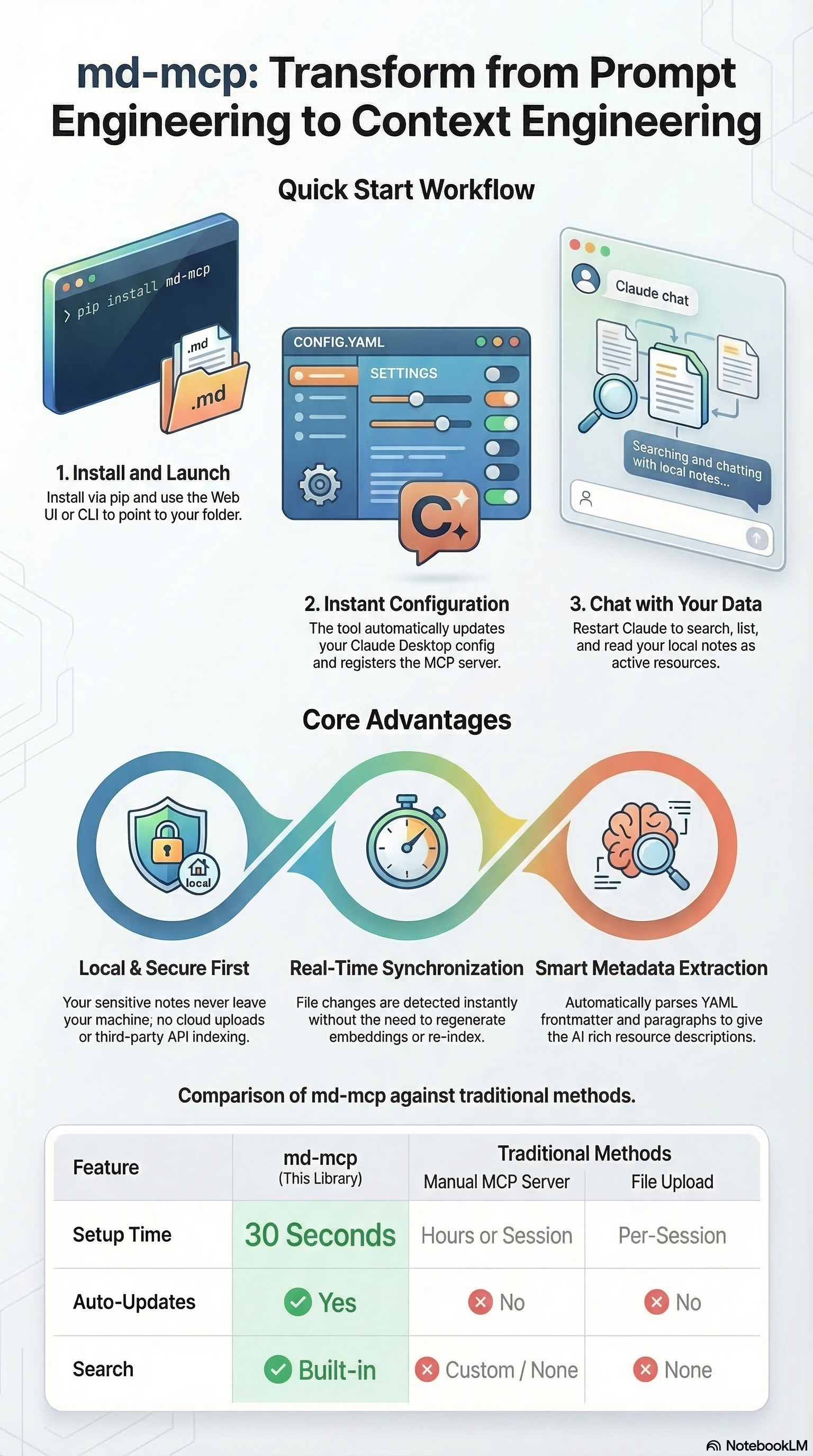
Transform from Prompt Engineering to Context Engineering.
A lightweight Python library that instantly exposes your local markdown documentation, notes, and knowledge bases to any AI tool that supports the Model Context Protocol (MCP) – including Claude Desktop.
No embeddings, no preprocessing, and no uploading. Your files stay safely on your local machine, and any real-time updates are instantly reflected in your AI's context.
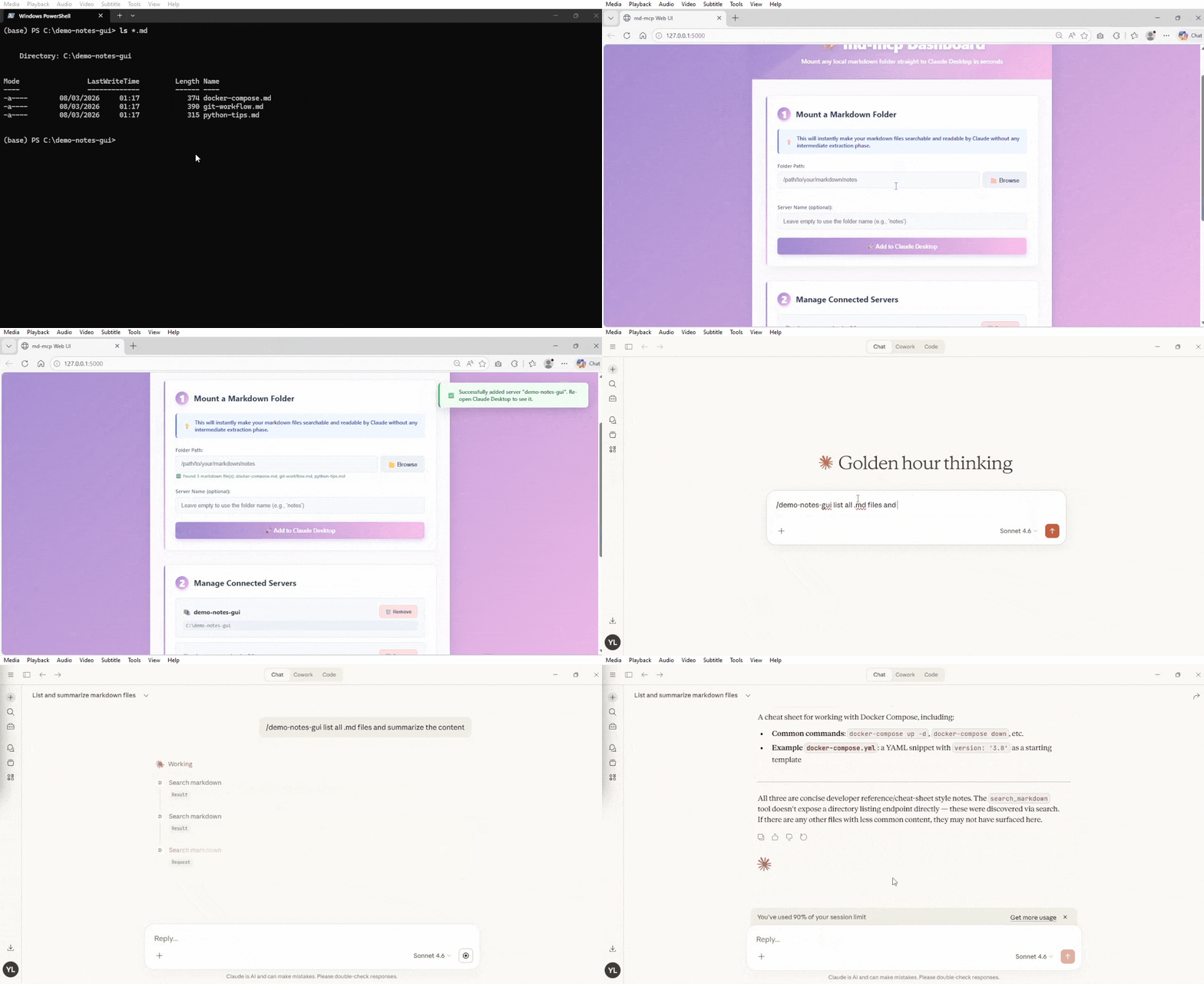
🚀 Quick Start
1. Install
Option A: Install from pypi
pip install md-mcp
Option B: Install from source code
pip install -e .
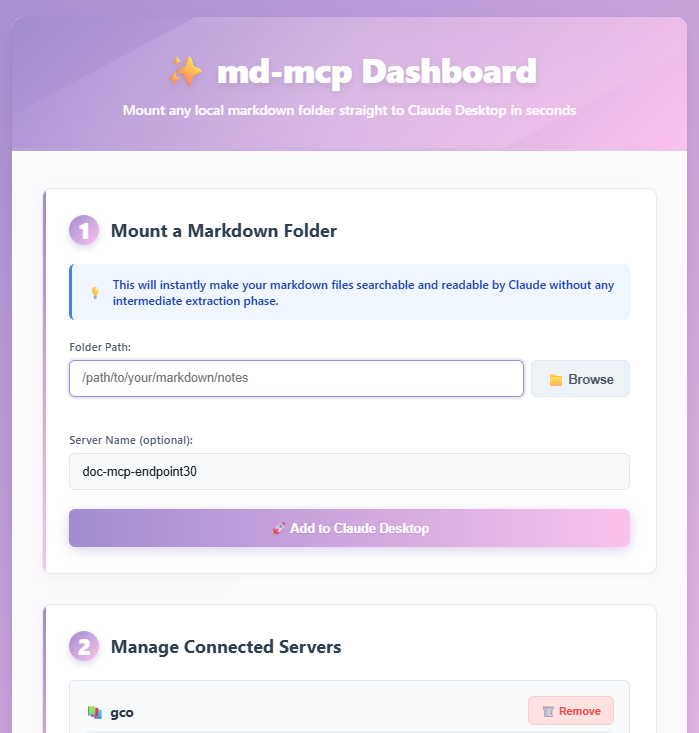
2. Launch the Web UI (Recommended)
The easiest way to manage your markdown servers is through the visual dashboard:
md-mcp --web
If the command is not recognized (e.g., if the Python scripts directory is not in your system PATH), you can run:
python -m md_mcp --web
Just point at a folder and go!
3. Or use the CLI
If you prefer the command line:
# Expose a folder of markdown files
md-mcp --folder ~/Documents/notes --name "My Notes"

# That's it! Restart Claude Desktop and it's available.
📋 Features
- Context Engineering: Feed your AI assistant exactly the right local context to get better answers, eliminating the need to endlessly prompt.
- Universal MCP Support: Works natively with Claude Desktop and any other AI tool or agent that supports the Model Context Protocol.
- Local & Secure First: Your files never leave your machine. No cloud uploads, no third-party APIs parsing your sensitive notes.
- Real-time Sync: Edit your markdown files and the MCP server picks up the changes instantly. No need to regenerate embeddings or re-index.
- Auto File Watching: Automatically detects when files are added, modified, or deleted (powered by watchdog). Use the
rescan_folder()tool in Claude Desktop for manual refresh if needed. - Zero Configuration: Just point at a folder and go.
- Auto-Discovery: Recursively finds all
.mdfiles. - Metadata Extraction: Parses YAML frontmatter and first paragraphs for rich resource descriptions.
- Search Support: Built-in search across all files to quickly find the needle in the haystack.
- Web Interface: Easy-to-use visual dashboard for non-technical users to manage multiple knowledge bases.
🎯 Use Cases
1. Personal Knowledge Base
md-mcp --folder ~/obsidian-vault --name "Obsidian"
→ Claude can now read your entire Obsidian vault
2. Project Documentation
md-mcp --folder ~/code/myproject/docs --name "Project Docs"
→ Claude has full context on your project
3. Research Papers
md-mcp --folder ~/research/papers-md --name "Research"
→ Claude can reference your research notes
📖 Advanced Usage commands
Web Interface (easiest way to use)
# Direct command (if in PATH)
md-mcp --web

# Or via Python module
python -m md_mcp --web

# You can optionally specify a custom port (default is 5000)
md-mcp --web --port 8080
# or: python -m md_mcp --web --port 8080
Add a Markdown Folder
# With explicit name
md-mcp --folder /path/to/docs --name "My Docs"

# Auto-name from folder
md-mcp --folder ~/notes
# Creates server named "notes"

# Alias: --add
md-mcp --add ~/work-docs --name "Work"
Scan Before Adding (Dry Run)
md-mcp --folder ~/notes --scan
# Shows what files would be exposed
List Configured Servers
md-mcp --list
# Shows all md-mcp servers
Show Configuration Status
md-mcp --status
# Shows Claude config path and all servers
Remove a Server
md-mcp --remove "My Docs"
Interactive Mode
md-mcp
# Prompts for folder path
🔧 How It Works
-
You run the CLI:
md-mcp --folder ~/notes --name "Notes" -
md-mcp:
- Scans folder for
.mdfiles - Extracts metadata (frontmatter, descriptions)
- Updates Claude Desktop config
- Registers MCP server entry
- Scans folder for
-
In Claude Desktop:
- Restart Claude
- Server appears in MCP dropdown
- All markdown files available as resources
- Use search tools to find content
📂 What Gets Exposed
Each markdown file becomes an MCP Resource:
{
  "uri": "md://notes/project-plan.md",
  "name": "Project Plan",
  "description": "Auto-extracted from frontmatter or first paragraph",
  "mimeType": "text/markdown"
}
🛠️ MCP Tools
md-mcp provides three tools to Claude:
1. search_markdown
Search across all markdown files by content or filename.
Usage in Claude:
- Standard (keyword): > "Search my notes for 'docker compose'"
⚠️ Experimental features below: (may not work)
- Semantic: > "Search my docs for 'user authentication' using semantic search" (Finds related concepts like login, OAuth, etc.)
- Hybrid: > "Search for 'docker setup' using hybrid search" (Combines exact matching and conceptual matching)
(Note: Semantic and hybrid search require pip install md-mcp[semantic])
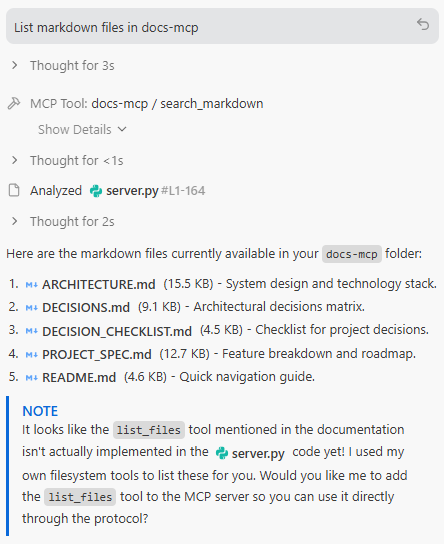
2. list_files
List all available markdown files.
Usage in Claude:
"What markdown files do I have about Python?"
3. rescan_folder
Manually rescan the folder for new, modified, or deleted markdown files. Use this if the automatic file watcher is not available or if files are missing.
Usage in Claude:
"Rescan the markdown folder to find my new notes"
📋 Requirements
- Python 3.10+
- mcp library
- Claude Desktop
🔧 Configuration
Claude Desktop Config Location (Automatic)
Windows: %APPDATA%\Claude\claude_desktop_config.json
macOS: ~/Library/Application Support/Claude/claude_desktop_config.json
Linux: ~/.config/Claude/claude_desktop_config.json
Antigravity Config Location (Manual)
Windows: %USERPROFILE%\.gemini\antigravity\mcp_config.json
Add your config and run Developer: Reload Window from the Command Palette (Ctrl+Shift+P).
Config Entry Format
{
  "mcpServers": {
    "my-notes": {
      "command": "C:\\Python\\python.exe",
      "args": [
        "-m", "md_mcp.server_runner",
        "--folder", "C:\\Users\\Yang\\notes",
        "--name", "my-notes"
      ]
    }
  }
}
VS Code MCP Config (Manual)
For workspace-level tools, use a file at .vscode/mcp.json. See official VS Code MCP documentation.
[!IMPORTANT] For workspace configs, the top-level key is
"servers", not"mcpServers".
Example .vscode/mcp.json:
{
  "servers": {
    "my-notes": {
      "command": "C:\\Python\\python.exe",
      "args": [
        "-m", "md_mcp.server_runner",
        "--folder", "C:\\Users\\Yang\\notes",
        "--name", "my-notes"
      ]
    }
  }
}
Sample Prompts to Test
Once configured, try these prompts with your AI assistant:
- "Search my-notes for 'Docker'"
- "List markdown files in my-notes"
- "What do my notes say about the system architecture?"
🧪 Testing
Test the Scanner
from md_mcp.scanner import MarkdownScanner

scanner = MarkdownScanner("~/notes")
files = scanner.scan()

for f in files:
    print(f"{f.name}: {f.description}")
Test the Server Locally
# Run server directly (stdio mode)
python -m md_mcp.server_runner --folder ~/notes --name test

# Server listens on stdin/stdout for MCP protocol
📝 Markdown Frontmatter Support
md-mcp extracts metadata from YAML frontmatter:
---
title: My Document
description: A brief overview of the document
tags: [project, planning]
---

# Content starts here
Extracted fields:
description→ Used as resource description- Other fields stored in
frontmatterdict
If no frontmatter, first paragraph is used as description.
🚧 Roadmap
- [ ] v0.3: Smart chunking for large files
- [ ] v0.4: Semantic search with embeddings
- [ ] v1.0: Use web UI for all operations
🐛 Troubleshooting
"Server not showing in Claude Desktop"
-
Check config was updated:
md-mcp --status -
Verify file exists:
# Windows type %APPDATA%\Claude\claude_desktop_config.json # Mac/Linux cat ~/.config/Claude/claude_desktop_config.json -
Restart Claude Desktop completely
"No files found"
# Check what scanner finds
md-mcp --folder ~/notes --scan
"Permission denied"
Make sure the folder is readable:
# Check permissions
ls -la ~/notes
🏗️ Architecture
┌─────────────────┐
│  Claude Desktop │
│   (MCP Client)  │
└────────┬────────┘
         │ stdio (JSON-RPC)
         │
┌────────▼────────┐
│  md-mcp Server  │
│  (MCP Protocol) │
└────────┬────────┘
         │
┌────────▼────────┐
│ MarkdownScanner │
│  (File Reader)  │
└────────┬────────┘
         │
   ┌─────▼──────┐
   │ Filesystem │
   │  (*.md)    │
   └────────────┘
🤝 Comparison to Alternatives
| Feature | md-mcp | Manual MCP Server | File Upload |
|---|---|---|---|
| Setup Time | 30 seconds | Hours | Per-session |
| Auto-Updates | ✅ | ❌ | ❌ |
| Full Folder | ✅ | ✅ | ❌ |
| Search | ✅ | Custom | ❌ |
| One Command | ✅ | ❌ | ❌ |
📚 Development
Setup Dev Environment
git clone https://github.com/ly2xxx/md-mcp.git
cd md-mcp
pip install -e ".[dev]"
Run Tests
pytest
Format Code
black md_mcp/
📄 License
This project is licensed under the MIT License - see the LICENSE file for details.
🙏 Credits
Inspired by:
- Model Context Protocol by Anthropic
- netshare - File sharing tool by Yang Li
📮 Contact
Issues: https://github.com/ly2xxx/md-mcp/issues
Built by: Yang Li
Date: 2026-02-16
🚀 Just point at a folder and go!
推荐服务器

Baidu Map
百度地图核心API现已全面兼容MCP协议,是国内首家兼容MCP协议的地图服务商。

Playwright MCP Server
一个模型上下文协议服务器,它使大型语言模型能够通过结构化的可访问性快照与网页进行交互,而无需视觉模型或屏幕截图。

Magic Component Platform (MCP)
一个由人工智能驱动的工具,可以从自然语言描述生成现代化的用户界面组件,并与流行的集成开发环境(IDE)集成,从而简化用户界面开发流程。

Audiense Insights MCP Server
通过模型上下文协议启用与 Audiense Insights 账户的交互,从而促进营销洞察和受众数据的提取和分析,包括人口统计信息、行为和影响者互动。

VeyraX
一个单一的 MCP 工具,连接你所有喜爱的工具:Gmail、日历以及其他 40 多个工具。

graphlit-mcp-server
模型上下文协议 (MCP) 服务器实现了 MCP 客户端与 Graphlit 服务之间的集成。 除了网络爬取之外,还可以将任何内容(从 Slack 到 Gmail 再到播客订阅源)导入到 Graphlit 项目中,然后从 MCP 客户端检索相关内容。

Kagi MCP Server
一个 MCP 服务器,集成了 Kagi 搜索功能和 Claude AI,使 Claude 能够在回答需要最新信息的问题时执行实时网络搜索。

e2b-mcp-server
使用 MCP 通过 e2b 运行代码。

Neon MCP Server
用于与 Neon 管理 API 和数据库交互的 MCP 服务器

Exa MCP Server
模型上下文协议(MCP)服务器允许像 Claude 这样的 AI 助手使用 Exa AI 搜索 API 进行网络搜索。这种设置允许 AI 模型以安全和受控的方式获取实时的网络信息。