
ms-graph-mcp
An MCP server for Microsoft Graph, exposing 60 tools across calendar, email, meetings, Teams chat, files, people, directory, tasks, and OneNote over stdio or Streamable HTTP.
README
ms-graph-mcp






A Model Context Protocol server for Microsoft Graph — 85 tools across mail, calendar, meetings (including transcripts), Teams chat, files, SharePoint, search, people, contacts, directory, tasks and OneNote, over stdio or Streamable HTTP.
Signs you in with your own Microsoft account — browser SSO, no token to paste, no client secret.
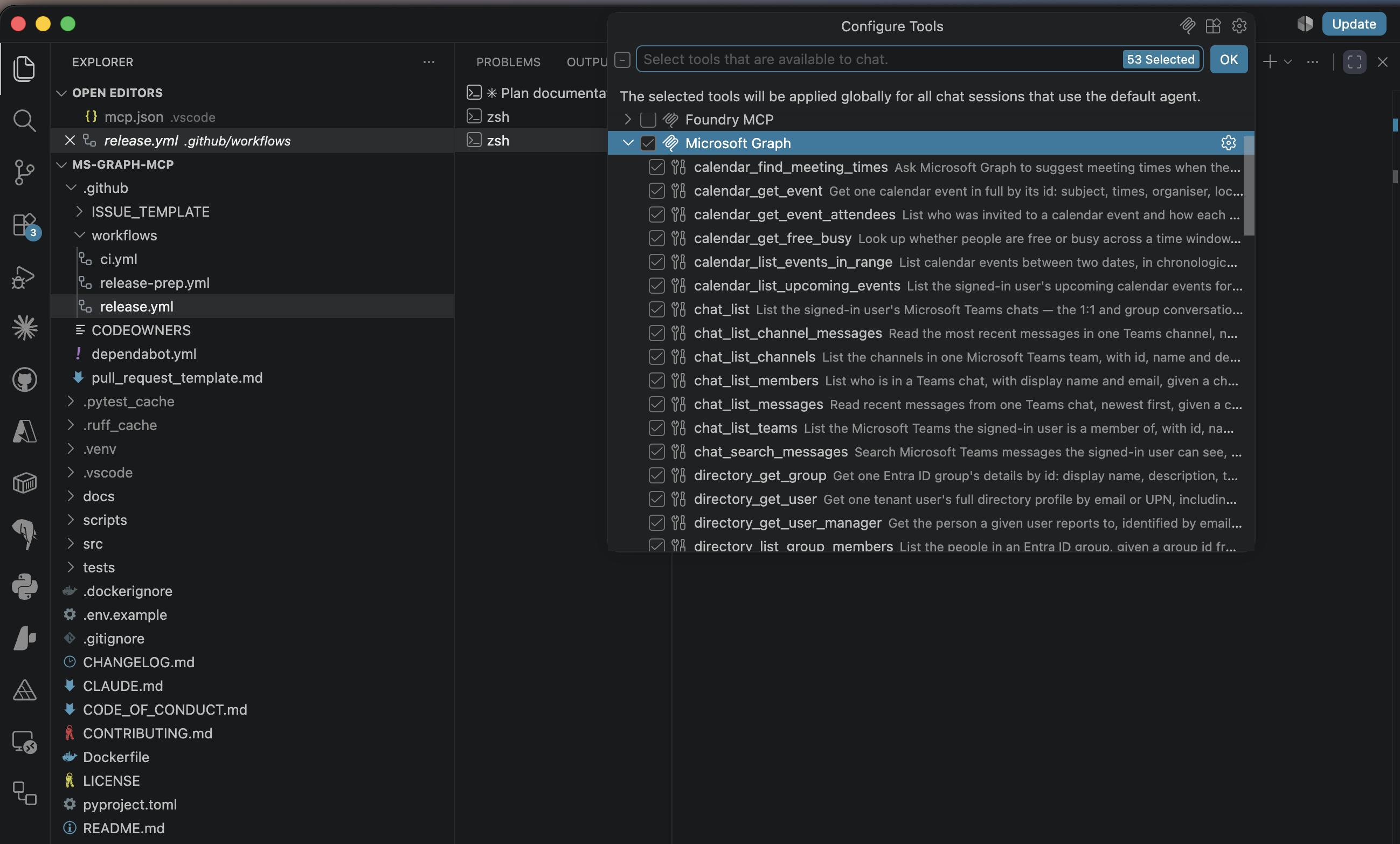
- No
msgraph-sdk, noazure-identity— the Graph client is rawhttpx, so the dependency tree stays small and the wire behaviour is inspectable. - Read/write separation is enforced, not advisory — write tools are hidden and refused unless the caller explicitly opts in.
- Auth-agnostic by default — tools receive an already-acquired Graph token via the request context. The server can also perform its own on-behalf-of exchange when you want it to act as a proper OAuth resource server.
Status: early. Extracted from a production agent platform where it has been running against a real tenant. The code is battle-tested; the packaging and public API surface are newer. Expect the config surface to move before 1.0.
Install
Requires Python 3.12+. Two paths — pick the one that matches what you want to do.
A. Use the package
Nothing to clone. uv runs it straight from PyPI:
uvx --from ms-graph-mcp ms-graph-mcp          # stdio, for an MCP client
uvx --from ms-graph-mcp ms-graph-mcp-http     # Streamable HTTP
or install it into an environment:
pip install ms-graph-mcp
Release candidates are published too. pip skips them unless you ask:
pip install --pre ms-graph-mcp          # newest, including candidates
pip install ms-graph-mcp==0.3.0rc1      # a specific one; no --pre needed for an exact pin
A container image is on GHCR for the HTTP transport — see docs/hosting.md.
TestPyPI is not a distribution channel. Every release is published there first, but that is a rehearsal of the publishing process: it can be wiped without notice and does not mirror PyPI, so installing from it needs
--extra-index-url https://pypi.org/simple/just to resolve ordinary dependencies. Use PyPI, or--pre.
B. Run from source
For hacking on it, forking it, or running an unreleased change:
git clone https://github.com/nitin27may/ms-graph-mcp
cd ms-graph-mcp
uv sync                       # creates .venv and installs everything
uv run ms-graph-mcp           # check it starts
uv sync is the only setup step. See
CONTRIBUTING.md before
opening a pull request — the tool allowlists and the tier separation have invariants that are
enforced rather than advisory.
To point an MCP client at your clone, you need its absolute path — clients do not inherit your
working directory and most do not expand ~:
cd ms-graph-mcp && pwd
# /Users/you/workspace/ms-graph-mcp
Then use the source form of the config in Configure your MCP client below.
Set up the Entra app
You need an Entra ID app registration — about two minutes. Do not create a client secret: this registers as a public client, which signs you in through your browser using PKCE. A secret on a program running on your own machine would be readable by anyone with the config file, which is why the flow is designed not to need one. Nothing goes into a config file except two ids, neither of which is sensitive.
In the Entra portal → App registrations → New registration:
- Name: anything, e.g.
ms-graph-mcp - Supported account types: Accounts in this organizational directory only
- Redirect URI: select Public client/native, value
http://localhost
Leave Certificates & secrets alone — you do not need anything from it.
Then, on the new app:
-
Authentication → enable Allow public client flows
-
API permissions → Add a permission → Microsoft Graph → Delegated permissions, and add what you want the agent to reach. A sensible read-only starting set:
User.Read  Mail.Read  Calendars.Read  Files.Read.All
People.Read  Chat.Read  Tasks.Read  Notes.Read  Contacts.Read
The complete copy-paste consent sets — and which permission each individual tool needs — are in docs/permissions.md.
Copy the Application (client) ID and Directory (tenant) ID from the Overview page. That is everything you need.
Configure your MCP client
Every MCP client that speaks stdio takes the same three things — a command, its arguments, and an environment block:
{
  "command": "uvx",
  "args": ["--from", "ms-graph-mcp", "ms-graph-mcp"],
  "env": {
    "GRAPH_MCP_CLIENT_ID": "<application-client-id>",
    "GRAPH_MCP_TENANT_ID": "<directory-tenant-id>"
  }
}
Where that block goes, and what the surrounding key is called, differs:
| Client | Config file | Key |
|---|---|---|
| VS Code | .vscode/mcp.json (workspace), or MCP: Open User Configuration |
servers |
| Claude Code | claude mcp add … — no file to edit |
— |
| Claude Desktop | macOS ~/Library/Application Support/Claude/claude_desktop_config.json · Windows %APPDATA%\Claude\claude_desktop_config.json |
mcpServers |
| Cursor | .cursor/mcp.json (project) or ~/.cursor/mcp.json (global) |
mcpServers |
| Windsurf | ~/.codeium/windsurf/mcp_config.json |
mcpServers |
| MCP Inspector | command line, -e flags |
— |
The first sign-in opens your browser for normal Microsoft 365 SSO — including MFA and conditional
access. The result is cached in ~/.ms-graph-mcp/token_cache.json, owner-readable only, so it does
not prompt again.
VS Code
{
  "inputs": [
    { "id": "clientId", "type": "promptString", "description": "Entra application (client) ID" },
    { "id": "tenantId", "type": "promptString", "description": "Entra directory (tenant) ID" }
  ],
  "servers": {
    "ms-graph": {
      "type": "stdio",
      "command": "uvx",
      "args": ["--from", "ms-graph-mcp", "ms-graph-mcp"],
      "env": {
        "GRAPH_MCP_CLIENT_ID": "${input:clientId}",
        "GRAPH_MCP_TENANT_ID": "${input:tenantId}"
      }
    }
  }
}
Reload the window. VS Code prompts once for the two ids and remembers them, so this file is safe to
commit. Open the Chat view, switch to Agent mode, and the tools appear under the tools picker —
that is the panel in the screenshot above. Confirm with MCP: List Servers, which shows status
and output if it does not connect.
Claude Code
claude mcp add ms-graph \
  --env GRAPH_MCP_CLIENT_ID=<application-client-id> \
  --env GRAPH_MCP_TENANT_ID=<directory-tenant-id> \
  -- uvx --from ms-graph-mcp ms-graph-mcp
Confirm with /mcp inside Claude Code — it lists the server and its tools.
Claude Desktop
{
  "mcpServers": {
    "ms-graph": {
      "command": "uvx",
      "args": ["--from", "ms-graph-mcp", "ms-graph-mcp"],
      "env": {
        "GRAPH_MCP_CLIENT_ID": "<application-client-id>",
        "GRAPH_MCP_TENANT_ID": "<directory-tenant-id>"
      }
    }
  }
}
Confirm by quitting Claude Desktop fully — not just closing the window — reopening it, and looking for the tools icon in the composer.
Cursor and Windsurf
Both use the same mcpServers shape as Claude Desktop, in the file named in the table above.
MCP Inspector
The quickest way to check the server independently of any client:
npx @modelcontextprotocol/inspector \
  uvx --from ms-graph-mcp ms-graph-mcp \
  -e GRAPH_MCP_CLIENT_ID=<application-client-id> \
  -e GRAPH_MCP_TENANT_ID=<directory-tenant-id>
Needs Node 22.19+. It opens a browser UI where you can list tools and call them by hand — worth
doing before blaming your client. There is a scriptable --cli mode too; see
docs/testing.md.
Pass variables with
-e, not from your shell. Inspector does not give the server it spawns your environment, soGRAPH_MCP_CLIENT_ID=… npx @modelcontextprotocol/inspector …starts the server with no client id. The-eflags go after the server command.
Running from source instead
Same blocks as above — swap the command and args for your clone's absolute path:
"command": "uv",
"args": ["run", "--directory", "/Users/you/workspace/ms-graph-mcp", "ms-graph-mcp"]
Two things catch people out here:
uv must be on the client's PATH. GUI apps launched from Finder or the Dock do not inherit your
shell's PATH, so a client can fail to start the server with an unhelpful error. If that happens, put
the output of which uv in "command" instead of the bare name.
--directory is not optional. Without it, uv run resolves against whatever directory the
client happened to launch from, which will not be the project.
Something not working?
docs/troubleshooting.md covers the Entra errors, Conditional Access, corporate TLS proxies, and the "server disconnected" that is almost always a startup error your client is hiding.
Configuration
Two settings get you running; everything else has a working default.
| Env var | Purpose |
|---|---|
GRAPH_MCP_CLIENT_ID |
Entra application (client) id. Enables interactive sign-in. |
GRAPH_MCP_TENANT_ID |
Entra directory (tenant) id. Defaults to common. |
GRAPH_MCP_SCOPES |
Comma-separated delegated scopes to request. Defaults to a read-only set. |
GRAPH_MCP_TOOLSETS |
Which tool profiles to expose. Defaults to core. See below. |
GRAPH_MCP_WRITE_SCOPE |
true to expose the 23 write tools. Default off. |
GRAPH_MCP_READ_ONLY |
true to remove the write tier from the deployment entirely. |
GRAPH_MCP_LOG_LEVEL |
INFO logs every Graph call to stderr. Defaults to WARNING. |
Every setting, both deployment shapes, and the hosted/OBO options are in docs/configuration.md. For running it as a service, see docs/hosting.md.
Toolset profiles
85 tools is a lot to put in front of a model. GRAPH_MCP_TOOLSETS selects named profiles, each a
group of namespaces:
| Profile | Namespaces | Read tools | Approx. tokens |
|---|---|---|---|
core (default) |
search, mail, calendar, files, people | 23 | ~4,200 |
mail |
5 | ~800 | |
calendar |
calendar | 6 | ~1,500 |
meetings |
meetings, calendar | 13 | ~2,900 |
files |
files | 6 | ~900 |
chat |
chat | 7 | ~1,000 |
people |
people | 5 | ~750 |
directory |
directory, people | 12 | ~1,900 |
tasks |
tasks | 5 | ~830 |
notes |
notes | 4 | ~570 |
search |
search | 1 | ~290 |
all |
everything | 53 | ~9,200 |
Combine them with commas:
GRAPH_MCP_TOOLSETS=mail,calendar,tasks
core is the default, so some tools are not advertised unless you ask for them. If you want
Teams chat, Planner, OneNote, meeting transcripts or directory lookups, name those profiles — or set
GRAPH_MCP_TOOLSETS=all to expose everything.
Over HTTP a caller may send X-Toolsets to narrow further for one request. It can only narrow.
The startup value is a ceiling, so a client asking for all gains nothing the deployment did not
already enable. This filters visibility, not authority — the write-scope and internal-tier gates
are what actually stop a call.
Tool surface
Three tiers, one auth seam.
| Tier | Count | Exposed when | Examples |
|---|---|---|---|
| Read | 53 | always | calendar_list_upcoming_events, mail_search, meetings_get_transcript, files_search, search_query |
| Write | 23 | X-Write-Scope: true |
mail_send, calendar_create_event, files_create_sharing_link, tasks_complete_todo |
| Internal | 9 | X-Internal-Scope: true, machine principal only |
graph_request passthrough, drive walk/upload, message attachments, app-only probe_graph_access |
The internal tier is not part of the agent surface. A model sees 76 agent-visible tools. By namespace: mail 11 · tasks 11 · calendar 10 · files 10 · chat 8 · directory 7 · meetings 7 · people 6 · notes 5 · search 1.
Tool names are namespaced by Graph permission family rather than by Microsoft product, because real
questions cross product boundaries — files_ covers OneDrive and SharePoint document libraries,
which are the same driveItem resource underneath.
Every tool declares MCP annotations (readOnlyHint, destructiveHint, idempotentHint) so clients
know what needs confirming, and every description names the delegated permission it requires.
Renamed in 0.2.0. Every pre-0.2.0 tool name still works as an alias, and will keep working until 0.4.0. Aliases are honoured by
tools/callbut never advertised intools/list, so they cost no context.
Documentation
| docs/ | Index of everything below |
| docs/configuration.md | Every environment variable, split by deployment shape |
| docs/permissions.md | Every tool and the delegated permission it needs, plus copy-paste consent sets |
| docs/hosting.md | Streamable HTTP, headers, Docker and GHCR |
| docs/troubleshooting.md | Entra errors, Conditional Access, corporate TLS proxies |
| docs/debugging.md | Logs, error codes, and the auth failures people actually hit |
| docs/graph-coverage.md | What this covers of the Graph v1.0 surface, what it does not, and what is out of scope |
| docs/roadmap.md | What is not done yet |
| docs/testing.md | Running the suite, how it is arranged, and MCP Inspector |
| CONTRIBUTING.md | Dev setup, the add-a-tool checklist, and the invariants enforced by tests |
| SECURITY.md | Reporting vulnerabilities, and what to change before exposing this beyond localhost |
| CHANGELOG.md | Release history |
| CLAUDE.md | Architecture and the non-obvious traps, for coding agents and new contributors alike |
What's next
SharePoint sites and lists are the largest gap; directory completion, file move/delete, and mail drafts follow. Sovereign clouds (GCC High / 21Vianet) are unsupported today. The full list, and what is deliberately out of scope, is in docs/roadmap.md.
Getting help
- Setup and app-registration questions → Discussions
- Bugs → Issues, with the output of running the server in a terminal
- Security vulnerabilities → never a public issue; see SECURITY.md
Never paste an access token, client secret or shared secret into any of them.
Contributing
Issues and pull requests are welcome. Start with CONTRIBUTING.md; participation is governed by the Code of Conduct.
uv sync
uv run pytest -q            # full suite, offline, about two seconds
uv run ruff check .
uv run ruff format .
License
MIT — see LICENSE.
推荐服务器

Baidu Map
百度地图核心API现已全面兼容MCP协议,是国内首家兼容MCP协议的地图服务商。

Playwright MCP Server
一个模型上下文协议服务器,它使大型语言模型能够通过结构化的可访问性快照与网页进行交互,而无需视觉模型或屏幕截图。

Magic Component Platform (MCP)
一个由人工智能驱动的工具,可以从自然语言描述生成现代化的用户界面组件,并与流行的集成开发环境(IDE)集成,从而简化用户界面开发流程。

Audiense Insights MCP Server
通过模型上下文协议启用与 Audiense Insights 账户的交互,从而促进营销洞察和受众数据的提取和分析,包括人口统计信息、行为和影响者互动。

VeyraX
一个单一的 MCP 工具,连接你所有喜爱的工具:Gmail、日历以及其他 40 多个工具。

graphlit-mcp-server
模型上下文协议 (MCP) 服务器实现了 MCP 客户端与 Graphlit 服务之间的集成。 除了网络爬取之外,还可以将任何内容(从 Slack 到 Gmail 再到播客订阅源)导入到 Graphlit 项目中,然后从 MCP 客户端检索相关内容。

Kagi MCP Server
一个 MCP 服务器,集成了 Kagi 搜索功能和 Claude AI,使 Claude 能够在回答需要最新信息的问题时执行实时网络搜索。

e2b-mcp-server
使用 MCP 通过 e2b 运行代码。

Neon MCP Server
用于与 Neon 管理 API 和数据库交互的 MCP 服务器

Exa MCP Server
模型上下文协议(MCP)服务器允许像 Claude 这样的 AI 助手使用 Exa AI 搜索 API 进行网络搜索。这种设置允许 AI 模型以安全和受控的方式获取实时的网络信息。