
Network AI
Multi-agent swarm orchestrator for AI workflows. Exposes blackboard read/write, agent dispatch, permission gating (AuthGuardian), token budget enforcement (FederatedBudget), and audit log tools over MCP. Supports 14 AI framework adapters including LangChain, AutoGen, CrewAI, Codex, and A2A — mix any frameworks in one swarm with race-condition-safe shared state.(Traffic light for agents)
README
Network-AI
TypeScript/Node.js multi-agent orchestrator — shared state, guardrails, budgets, and cross-framework coordination











Network-AI is a TypeScript/Node.js multi-agent orchestrator that adds coordination, guardrails, and governance to any AI agent stack.
- Shared blackboard with locking — atomic
propose → validate → commitprevents race conditions and split-brain failures across parallel agents - Guardrails and budgets — FSM governance, per-agent token ceilings, HMAC audit trails, and permission gating
- 14 adapters — LangChain (+ streaming), AutoGen, CrewAI, OpenAI Assistants, LlamaIndex, Semantic Kernel, Haystack, DSPy, Agno, MCP, Custom (+ streaming), OpenClaw, A2A, and Codex — no glue code, no lock-in
The silent failure mode in multi-agent systems: parallel agents writing to the same key use last-write-wins by default — one agent's result silently overwrites another's mid-flight. The outcome is split-brain state: double-spends, contradictory decisions, corrupted context, no error thrown. Network-AI's
propose → validate → commitmutex prevents this at the coordination layer, before any write reaches shared state.
Use Network-AI as:
- A TypeScript/Node.js library —
import { createSwarmOrchestrator } from 'network-ai' - An MCP server —
npx network-ai-server --port 3001 - An OpenClaw skill —
clawhub install network-ai
5-minute quickstart → | Architecture → | All adapters → | Benchmarks →
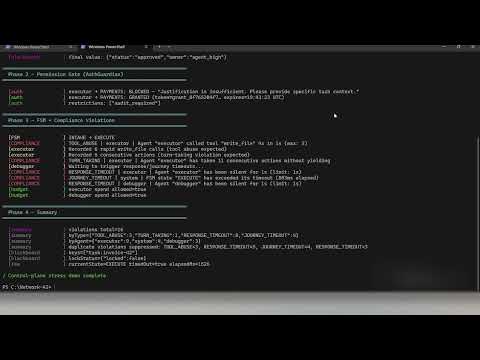
Try the control-plane stress test — no API key, ~3 seconds:
npx ts-node examples/08-control-plane-stress-demo.tsRuns priority preemption, AuthGuardian permission gating, FSM governance, and compliance monitoring against a live swarm. No external services required.
If it saves you from a race condition, a ⭐ helps others find it.
Why teams use Network-AI
| Problem | How Network-AI solves it |
|---|---|
| Race conditions in parallel agents | Atomic blackboard: propose → validate → commit with file-system mutex |
| Agent overspend / runaway costs | FederatedBudget — hard per-agent token ceilings with live spend tracking |
| No visibility into what agents did | HMAC-signed audit log on every write, permission grant, and FSM transition |
| Locked into one AI framework | 14 adapters — mix LangChain + AutoGen + CrewAI + Codex + custom in one swarm |
| Agents escalating beyond their scope | AuthGuardian — scoped permission tokens required before sensitive operations |
Architecture
%%{init: {'theme': 'base', 'themeVariables': {'primaryColor': '#1e293b', 'primaryTextColor': '#e2e8f0', 'primaryBorderColor': '#475569', 'lineColor': '#94a3b8', 'clusterBkg': '#0f172a', 'clusterBorder': '#334155', 'edgeLabelBackground': '#1e293b', 'edgeLabelColor': '#cbd5e1', 'titleColor': '#e2e8f0'}}}%%
flowchart TD
    classDef app        fill:#1e3a5f,stroke:#3b82f6,color:#bfdbfe,font-weight:bold
    classDef security   fill:#451a03,stroke:#d97706,color:#fde68a
    classDef routing    fill:#14532d,stroke:#16a34a,color:#bbf7d0
    classDef quality    fill:#3b0764,stroke:#9333ea,color:#e9d5ff
    classDef blackboard fill:#0c4a6e,stroke:#0284c7,color:#bae6fd
    classDef adapters   fill:#064e3b,stroke:#059669,color:#a7f3d0
    classDef audit      fill:#1e293b,stroke:#475569,color:#94a3b8

    App["Your Application"]:::app
    App -->|"createSwarmOrchestrator()"| SO

    subgraph SO["SwarmOrchestrator"]
        AG["AuthGuardian\n(permission gating)"]:::security
        AR["AdapterRegistry\n(route tasks to frameworks)"]:::routing
        QG["QualityGateAgent\n(validate blackboard writes)"]:::quality
        BB["SharedBlackboard\n(shared agent state)\npropose → validate → commit\nfilesystem mutex"]:::blackboard
        AD["Adapters — plug any framework in, swap freely\nLangChain · AutoGen · CrewAI · MCP · LlamaIndex · …"]:::adapters

        AG -->|"grant / deny"| AR
        AR -->|"tasks dispatched"| AD
        AD -->|"writes results"| BB
        QG -->|"validates"| BB
    end

    SO --> AUDIT["data/audit_log.jsonl"]:::audit
FederatedBudgetis a standalone export — instantiate it separately and optionally wire it to a blackboard backend for cross-node token budget enforcement.
→ Full architecture, FSM journey, and handoff protocol
Install
npm install network-ai
No native dependencies, no build step. Adapters are dependency-free (BYOC — bring your own client).
Use as MCP Server
Start the server (no config required, zero dependencies):
npx network-ai-server --port 3001
# or from source:
npx ts-node bin/mcp-server.ts --port 3001
Then wire any MCP-compatible client to it.
Claude Desktop — add to ~/Library/Application Support/Claude/claude_desktop_config.json (macOS) or %APPDATA%\Claude\claude_desktop_config.json (Windows):
{
  "mcpServers": {
    "network-ai": {
      "url": "http://localhost:3001/sse"
    }
  }
}
Cursor / Cline / any SSE-based MCP client — point to the same URL:
{
  "mcpServers": {
    "network-ai": {
      "url": "http://localhost:3001/sse"
    }
  }
}
Verify it's running:
curl http://localhost:3001/health   # { "status": "ok", "tools": <n>, "uptime": <ms> }
curl http://localhost:3001/tools    # full tool list
Tools exposed over MCP:
blackboard_read/blackboard_write/blackboard_list/blackboard_delete/blackboard_existsbudget_status/budget_spend/budget_reset— federated token trackingtoken_create/token_validate/token_revoke— HMAC-signed permission tokensaudit_query— query the append-only audit logconfig_get/config_set— live orchestrator configurationagent_list/agent_spawn/agent_stop— agent lifecyclefsm_transition— write FSM state transitions to the blackboard
Each tool takes an agent_id parameter — all writes are identity-verified and namespace-scoped, exactly as they are in the TypeScript API.
Options: --no-budget, --no-token, --no-control, --ceiling <n>, --board <name>, --audit-log <path>.
Two agents, one shared state — without race conditions
The real differentiator is coordination. Here is what no single-framework solution handles: two agents writing to the same resource concurrently, atomically, without corrupting each other.
import { LockedBlackboard, CustomAdapter, createSwarmOrchestrator } from 'network-ai';

const board   = new LockedBlackboard('.');
const adapter = new CustomAdapter();

// Agent 1: writes its analysis result atomically
adapter.registerHandler('analyst', async () => {
  const id = board.propose('report:status', { phase: 'analysis', complete: true }, 'analyst');
  board.validate(id, 'analyst');
  board.commit(id);                           // file-system mutex — no race condition possible
  return { result: 'analysis written' };
});

// Agent 2: runs concurrently, writes to its own key safely
adapter.registerHandler('reviewer', async () => {
  const id = board.propose('report:review', { approved: true }, 'reviewer');
  board.validate(id, 'reviewer');
  board.commit(id);
  const analysis = board.read('report:status');
  return { result: `reviewed phase=${analysis?.phase}` };
});

createSwarmOrchestrator({ adapters: [{ adapter }] });

// Both fire concurrently — mutex guarantees no write is ever lost
const [, ] = await Promise.all([
  adapter.executeAgent('analyst',  { action: 'run', params: {} }, { agentId: 'analyst' }),
  adapter.executeAgent('reviewer', { action: 'run', params: {} }, { agentId: 'reviewer' }),
]);

console.log(board.read('report:status'));   // { phase: 'analysis', complete: true }
console.log(board.read('report:review'));   // { approved: true }
Add budgets, permissions, and cross-framework agents with the same pattern. → QUICKSTART.md
Demo — Control-Plane Stress Test (no API key)
Runs in ~3 seconds. Proves the coordination primitives without any LLM calls.
npm run demo -- --08
What it shows: atomic blackboard locking, priority preemption (priority-3 wins over priority-0 on same key), AuthGuardian permission gate (blocked → justified → granted with token), FSM hard-stop at 700 ms, live compliance violation capture (TOOL_ABUSE, TURN_TAKING, RESPONSE_TIMEOUT, JOURNEY_TIMEOUT), and FederatedBudget tracking — all without a single API call.
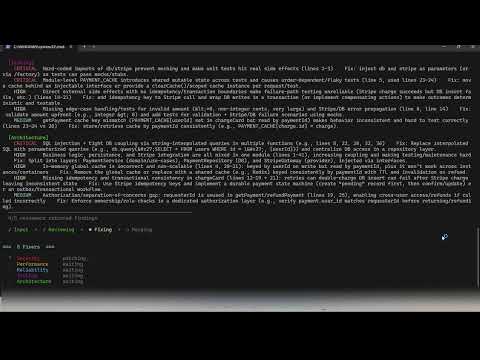
8-agent AI pipeline (requires OPENAI_API_KEY — builds a Payment Processing Service end-to-end):
npm run demo -- --07
Adapter System
14 adapters, zero adapter dependencies. You bring your own SDK objects.
| Adapter | Framework / Protocol | Register method |
|---|---|---|
CustomAdapter |
Any function or HTTP endpoint | registerHandler(name, fn) |
LangChainAdapter |
LangChain | registerAgent(name, runnable) |
AutoGenAdapter |
AutoGen / AG2 | registerAgent(name, agent) |
CrewAIAdapter |
CrewAI | registerAgent or registerCrew |
MCPAdapter |
Model Context Protocol | registerTool(name, handler) |
LlamaIndexAdapter |
LlamaIndex | registerQueryEngine(), registerChatEngine() |
SemanticKernelAdapter |
Microsoft Semantic Kernel | registerKernel(), registerFunction() |
OpenAIAssistantsAdapter |
OpenAI Assistants | registerAssistant(name, config) |
HaystackAdapter |
deepset Haystack | registerPipeline(), registerAgent() |
DSPyAdapter |
Stanford DSPy | registerModule(), registerProgram() |
AgnoAdapter |
Agno (formerly Phidata) | registerAgent(), registerTeam() |
OpenClawAdapter |
OpenClaw | registerSkill(name, skillRef) |
A2AAdapter |
Google A2A Protocol | registerRemoteAgent(name, url) |
CodexAdapter |
OpenAI Codex / gpt-4o / Codex CLI | registerCodexAgent(name, config) |
Streaming variants (drop-in replacements with .stream() support):
| Adapter | Extends | Streaming source |
|---|---|---|
LangChainStreamingAdapter |
LangChainAdapter |
Calls .stream() on the Runnable if available; falls back to .invoke() |
CustomStreamingAdapter |
CustomAdapter |
Pipes AsyncIterable<string> handlers; falls back to single-chunk for plain Promises |
Extend BaseAdapter (or StreamingBaseAdapter for streaming) to add your own in minutes. See references/adapter-system.md.
Works with LangGraph, CrewAI, and AutoGen
Network-AI is the coordination layer you add on top of your existing stack. Keep your LangChain chains, CrewAI crews, and AutoGen agents — and add shared state, governance, and budgets around them.
| Capability | Network-AI | LangGraph | CrewAI | AutoGen |
|---|---|---|---|---|
| Cross-framework agents in one swarm | ✅ 14 built-in adapters | ⚠️ Nodes can call any code; no adapter abstraction | ⚠️ Extensible via tools; CrewAI-native agents only | ⚠️ Extensible via plugins; AutoGen-native agents only |
| Atomic shared state (conflict-safe) | ✅ propose → validate → commit mutex |
⚠️ State passed between nodes; last-write-wins | ⚠️ Shared memory available; no conflict resolution | ⚠️ Shared context available; no conflict resolution |
| Hard token ceiling per agent | ✅ FederatedBudget (first-class API) |
⚠️ Via callbacks / custom middleware | ⚠️ Via callbacks / custom middleware | ⚠️ Built-in token tracking in v0.4+; no swarm-level ceiling |
| Permission gating before sensitive ops | ✅ AuthGuardian (built-in) |
⚠️ Possible via custom node logic | ⚠️ Possible via custom tools | ⚠️ Possible via custom middleware |
| Append-only audit log | ✅ plain JSONL (data/audit_log.jsonl) |
⚠️ Not built-in | ⚠️ Not built-in | ⚠️ Not built-in |
| Encryption at rest | ✅ AES-256-GCM (TypeScript layer) | ⚠️ Not built-in | ⚠️ Not built-in | ⚠️ Not built-in |
| Language | TypeScript / Node.js | Python | Python | Python |
Testing
npm run test:all          # All suites in sequence
npm test                  # Core orchestrator
npm run test:security     # Security module
npm run test:adapters     # All 14 adapters
npm run test:streaming    # Streaming adapters
npm run test:a2a          # A2A protocol adapter
npm run test:codex        # Codex adapter
npm run test:priority     # Priority & preemption
1,334 passing assertions across 16 test suites (npm run test:all):
| Suite | Assertions | Covers |
|---|---|---|
test-phase4.ts |
147 | FSM governance, compliance monitor, adapter integration |
test-phase5f.ts |
127 | SSE transport, McpCombinedBridge, extended MCP tools |
test-phase5g.ts |
121 | CRDT backend, vector clocks, bidirectional sync |
test-phase6.ts |
121 | MCP server, control-plane tools, audit tools |
test-adapters.ts |
140 | All 14 adapters, registry routing, integration, edge cases |
test-phase5d.ts |
117 | Pluggable backend (Redis, CRDT, Memory) |
test-standalone.ts |
88 | Blackboard, auth, integration, persistence, parallelisation, quality gate |
test-phase5e.ts |
87 | Federated budget tracking |
test-phase5c.ts |
73 | Named multi-blackboard, isolation, backend options |
test-codex.ts |
51 | Codex adapter: chat, completion, CLI, BYOC client, error paths |
test-priority.ts |
64 | Priority preemption, conflict resolution, backward compat |
test-a2a.ts |
35 | A2A protocol: register, execute, mock fetch, error paths |
test-streaming.ts |
32 | Streaming adapters, chunk shapes, fallback, collectStream |
test-phase5b.ts |
55 | Pluggable backend part 2, consistency levels |
test-phase5.ts |
42 | Named multi-blackboard base |
test-security.ts |
34 | Tokens, sanitization, rate limiting, encryption, audit |
Documentation
| Doc | Contents |
|---|---|
| QUICKSTART.md | Installation, first run, PowerShell guide, Python scripts CLI |
| ARCHITECTURE.md | Race condition problem, FSM design, handoff protocol, project structure |
| BENCHMARKS.md | Provider performance, rate limits, local GPU, max_completion_tokens guide |
| SECURITY.md | Security module, permission system, trust levels, audit trail |
| ENTERPRISE.md | Evaluation checklist, stability policy, security summary, integration entry points |
| AUDIT_LOG_SCHEMA.md | Audit log field reference, all event types, scoring formula |
| ADOPTERS.md | Known adopters — open a PR to add yourself |
| INTEGRATION_GUIDE.md | End-to-end integration walkthrough |
| references/adapter-system.md | Adapter architecture, writing custom adapters |
| references/auth-guardian.md | Permission scoring, resource types |
| references/trust-levels.md | Trust level configuration |
Contributing
- Fork → feature branch →
npm run test:all→ pull request - Bugs and feature requests via Issues
MIT License — LICENSE · CHANGELOG · CONTRIBUTING ·

<details> <summary>Keywords</summary>
multi-agent · agent orchestration · AI agents · agentic AI · agentic workflow · TypeScript · Node.js · LangGraph · CrewAI · AutoGen · MCP · model-context-protocol · LlamaIndex · Semantic Kernel · OpenAI Assistants · Haystack · DSPy · Agno · OpenClaw · ClawHub · shared state · blackboard pattern · atomic commits · guardrails · token budgets · permission gating · audit trail · agent coordination · agent handoffs · governance · cost-awareness
</details>
推荐服务器

Baidu Map
百度地图核心API现已全面兼容MCP协议,是国内首家兼容MCP协议的地图服务商。

Playwright MCP Server
一个模型上下文协议服务器,它使大型语言模型能够通过结构化的可访问性快照与网页进行交互,而无需视觉模型或屏幕截图。

Magic Component Platform (MCP)
一个由人工智能驱动的工具,可以从自然语言描述生成现代化的用户界面组件,并与流行的集成开发环境(IDE)集成,从而简化用户界面开发流程。

Audiense Insights MCP Server
通过模型上下文协议启用与 Audiense Insights 账户的交互,从而促进营销洞察和受众数据的提取和分析,包括人口统计信息、行为和影响者互动。

VeyraX
一个单一的 MCP 工具,连接你所有喜爱的工具:Gmail、日历以及其他 40 多个工具。

graphlit-mcp-server
模型上下文协议 (MCP) 服务器实现了 MCP 客户端与 Graphlit 服务之间的集成。 除了网络爬取之外,还可以将任何内容(从 Slack 到 Gmail 再到播客订阅源)导入到 Graphlit 项目中,然后从 MCP 客户端检索相关内容。

Kagi MCP Server
一个 MCP 服务器,集成了 Kagi 搜索功能和 Claude AI,使 Claude 能够在回答需要最新信息的问题时执行实时网络搜索。

e2b-mcp-server
使用 MCP 通过 e2b 运行代码。

Neon MCP Server
用于与 Neon 管理 API 和数据库交互的 MCP 服务器

Exa MCP Server
模型上下文协议(MCP)服务器允许像 Claude 这样的 AI 助手使用 Exa AI 搜索 API 进行网络搜索。这种设置允许 AI 模型以安全和受控的方式获取实时的网络信息。