
sqlproctor
Enables deterministic semantic verification of agent-generated SQL queries against a git-versioned contract, blocking incorrect queries and returning structured feedback for self-correction.
README
sqlproctor
Deterministic semantic verification for agent-generated SQL.
Security firewalls stop malicious queries. Nothing stops wrong ones. sqlproctor is the missing piece: it sits between an AI agent and a database, holds a git-versioned semantic contract, and verifies every query the agent writes against that contract before it runs. Violations come back as structured feedback the agent uses to fix its own query. Every query and verdict is written to an append-only ledger.
A query can parse, execute, and still be quietly, confidently wrong: a hallucinated column, a join along the wrong key, a missing soft-delete filter, an aggregate silently inflated by a fan-out join. Those are the failures that reach a dashboard and lose the room. sqlproctor catches them structurally, with no second LLM in the loop.
If your agents run against a usage-billed warehouse (BigQuery, Snowflake, Athena), correctness is not the only win: every query the guard blocks is compute you never pay for, and because fan-outs and unfiltered scans are both the wrong answers and the expensive ones, you stop funding the agent's bad attempts instead of just catching them.
The five checks
| Check | Catches | Example it blocks |
|---|---|---|
| SURFACE | hallucinated tables and columns | SUM(orders.total_amount) when that column does not exist |
| JOIN_PATH | joins along an undeclared relationship | orders.order_id = customers.customer_id |
| REQUIRED_FILTER | a missing mandatory predicate | revenue query with no deleted_at IS NULL |
| FAN_OUT | additive aggregates over multiplied rows | SUM(order_items.net_amount) while also joined to shipments |
| METRIC | a metric computed off-grain | AVG(order_items.net_amount) AS revenue |
All of these parse and execute. All of them return the wrong number. The core is a set of structural checks over the parsed query (built on sqlglot, roughly 30 SQL dialects), so it is deterministic and explainable.
Install
pip install sqlproctor
The sqlproctor CLI checks a query against the contract it must satisfy:
sqlproctor check your_query.sql --contract your_contract.yml
See it in action (from source)
The demos, example contracts, and tests live in the repo and are not shipped in the package, so clone to run them:
git clone https://github.com/debabsah/sqlproctor && cd sqlproctor
pip install -e ".[dev]"
python examples/seed.py          # builds the demo DuckDB (reproducible, fixed seed)
python demo/demo.py              # watch an agent get blocked, correct itself, and pass
sqlproctor check examples/queries/revenue_by_region_bad.sql
The before/after
The demo seeds a real retail warehouse and asks one ordinary question: revenue by region. The naive query joins shipments and silently inflates revenue from the true $3,550,201 to $8,767,834, a 2.47x overstatement. sqlproctor blocks it, explains the fan-out, the agent drops the join, and the corrected query returns the true number with a verified against contract v1 badge. All figures come from the seeded database, not from hand-written asserts.
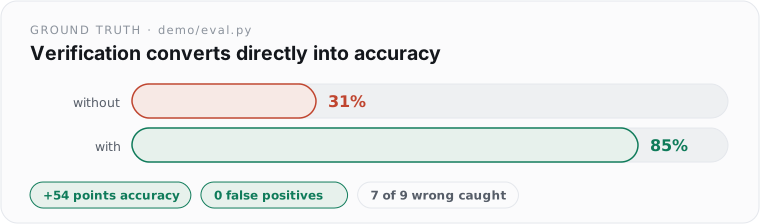
The accuracy benchmark (python demo/eval.py) runs a mix of correct and wrong queries with known outcomes. On the current set of 13:
| Metric | Result |
|---|---|
| Wrong queries caught | 7 of 9 (78%) |
| False positives on correct queries | 0 |
| Agent accuracy without sqlproctor | 31% |
| Agent accuracy with sqlproctor | 85% |
| Uplift | +54 points |
Two of the nine wrong queries are deliberately beyond what a schema-level contract can see (a status typo and a metric mislabelled under a non-metric alias), so the 78% is an honest denominator, not a rigged 100%. The +54-point uplift is the whole thesis in one number: verification converts directly into accuracy.
Proof: this happens to frontier models, not just hand-written queries
The benchmark above answers one question (does the guard convert to accuracy: yes, 31% to 85%). demo/live_eval.py answers the harder one: do real models, given only the CREATE TABLE schema and never the contract's rules, produce these errors on their own? We ran five models (Claude Opus 4.8, Gemini 3.1 Pro, GPT-5.5, GLM-5.2, and a local Qwen 3.6) across three schemas: the retail and SaaS demos plus the industry-standard TPC-DS benchmark. Every figure below is provenance-stamped in results/RESULTS.md and reproducible.
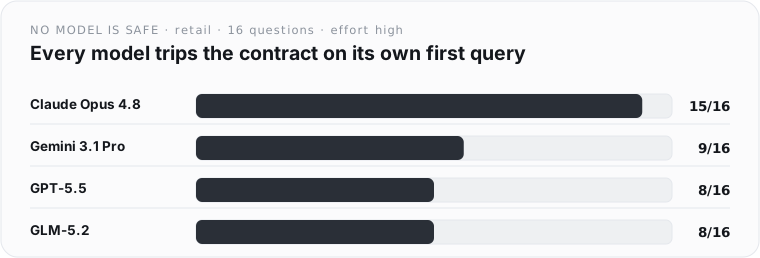
Every model trips the contract on its own first query. On the retail schema (16 questions, reasoning effort high):
| Model | First query blocked | Self-corrected | Reached a verified answer |
|---|---|---|---|
| Claude Opus 4.8 | 15 / 16 | 15 / 15 | 16 / 16 |
| Gemini 3.1 Pro | 9 / 16 | 9 / 9 | 16 / 16 |
| GPT-5.5 | 8 / 16 | 8 / 8 | 16 / 16 |
| GLM-5.2 | 8 / 16 | 6 / 8 | 14 / 16 |
This is not a capability ranking. Opus blocks highest because it writes direct SQL without defensively guessing the hidden soft-delete rule; no model can infer these business rules from DDL alone. Each one self-corrects once the guard hands back the specific violation.
The credibility centerpiece. Asked "total quantity of items sold by shipping carrier" (true answer 40,756), Claude Opus 4.8 and Gemini 3.1 Pro independently wrote the identical CTE-laundered fan-out and both returned 101,027 (a 2.48x overstatement). V1 missed it; these runs exposed the blind spot; it is now closed (docs/LIMITATIONS.md #1). GPT-5.5 gave a defensible 47,138; GLM-5.2 held the line and emitted no number rather than a wrong one. Finding our own hole across two frontier models and closing it is the loop working on the tool itself.
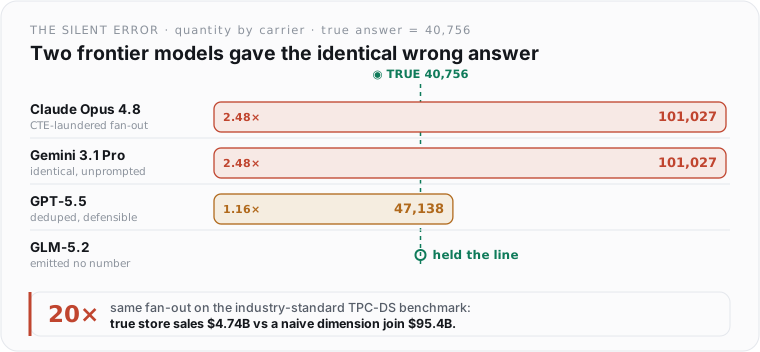
On a recognized benchmark. On TPC-DS, all three frontier models wrote the store-sales fan-out from the schema alone: true store sales are $4.74B, and a naive join through a shared dimension inflates that to $95.4B, a 20x silent overstatement. The guard blocked it and every model self-corrected.
Run it yourself (no rules leaked into the prompt; the model self-corrects on the structured feedback):
pip install -e ".[demo-live]"                        # anthropic + openai SDKs
export OPENROUTER_API_KEY=...                         # or ANTHROPIC_API_KEY for Claude direct
export SQLPROCTOR_LLM_PROVIDER=openrouter SQLPROCTOR_LLM_MODEL=z-ai/glm-5.2
python demo/live_eval.py --schema tpcds              # or: retail | saas
Offline self-test (no key): python demo/live_eval.py --selftest. Every run stamps provenance (timestamp, git commit, model, contract hash) to results/ and writes a full per-turn transcript to results/transcripts/.
The honest boundary
- "Verified" means contract-clean, not ground-truth-correct. A query the contract does not model can still be wrong, which is exactly why the carrier case above matters.
- Blocked-rate is not model quality, and the dollar magnitudes are properties of the seeded data, not facts about your warehouse. What transfers is the mechanism (a deterministic catch of silent, multiplicative errors) and the ground-truth rate (31% to 85%).
The semantic contract
A contract is plain YAML, versioned in git. It declares the tables, keys, legal join edges, mandatory predicates, and metric grains that a correct query must respect. See contracts/retail.yml.
You do not hand-write it from scratch. sqlproctor bootstrap generates the tedious surface (tables, columns, keys, join graph) from a live database, and you curate the delta that schema cannot express: the mandatory filters and the metric definitions.
How it plugs in
sqlproctor ships as a Model Context Protocol (MCP) server exposing one verified query tool over an embedded DuckDB. Point any MCP client (for example Claude) at it, and every query the agent runs is verified first: blocked queries return structured violations for self-correction, passing queries return rows tagged with the contract version. The same core runs as a CLI check for SQL in pull requests, and as an importable library inside any text-to-SQL product.
Pass-through mode
sqlproctor can run as a verifying proxy in front of an existing database MCP server. The agent talks only to sqlproctor; verified queries are forwarded to the upstream, blocked ones never reach it. No change to the agent or the upstream, config only:
export SQLPROCTOR_UPSTREAM_CMD="python -m your_database_mcp"   # the upstream stdio server
export SQLPROCTOR_UPSTREAM_TOOL=query                          # its SQL tool (default: query)
export SQLPROCTOR_UPSTREAM_SQL_ARG=sql                         # that tool's SQL arg (default: sql)
export SQLPROCTOR_CONTRACT=contracts/your_warehouse.yml
export SQLPROCTOR_DIALECT=tsql                                 # match the upstream (e.g. SQL Server)
sqlproctor serve
See it locally against a stand-in upstream server:
python demo/passthrough_demo.py
Two honest gaps to close before this is production dogfooding against a real SQL Server estate:
- Contract bootstrap is DuckDB-only.
sqlproctor bootstrapreadsduckdb_constraints(); a SQL Server bootstrap (overinformation_schemaplus the SQL Server key views) is not written yet, so the contract is hand-authored or partially bootstrapped for now. - The
tsqlverify path is not yet exercised against a real SQL Server contract. The checks are dialect-general (sqlglot parses T-SQL), but this needs a real-schema test. - The upstream connects per query; hold a persistent session if latency matters.
Status
V1, validated. The five checks are ported from a proven feasibility spike and exercised against three schemas and five models (see the proof above). One blind spot the runs surfaced, a CTE-laundered fan-out that fooled two frontier models, has been found and closed; the remaining known limitations are documented honestly in docs/LIMITATIONS.md. This is a validation milestone, not a finished product: a SQL Server bootstrap and a real-warehouse dogfood are still open (see pass-through mode above).
License
MIT. See LICENSE.
推荐服务器

Baidu Map
百度地图核心API现已全面兼容MCP协议,是国内首家兼容MCP协议的地图服务商。

Playwright MCP Server
一个模型上下文协议服务器,它使大型语言模型能够通过结构化的可访问性快照与网页进行交互,而无需视觉模型或屏幕截图。

Magic Component Platform (MCP)
一个由人工智能驱动的工具,可以从自然语言描述生成现代化的用户界面组件,并与流行的集成开发环境(IDE)集成,从而简化用户界面开发流程。

Audiense Insights MCP Server
通过模型上下文协议启用与 Audiense Insights 账户的交互,从而促进营销洞察和受众数据的提取和分析,包括人口统计信息、行为和影响者互动。

VeyraX
一个单一的 MCP 工具,连接你所有喜爱的工具:Gmail、日历以及其他 40 多个工具。

graphlit-mcp-server
模型上下文协议 (MCP) 服务器实现了 MCP 客户端与 Graphlit 服务之间的集成。 除了网络爬取之外,还可以将任何内容(从 Slack 到 Gmail 再到播客订阅源)导入到 Graphlit 项目中,然后从 MCP 客户端检索相关内容。

Kagi MCP Server
一个 MCP 服务器,集成了 Kagi 搜索功能和 Claude AI,使 Claude 能够在回答需要最新信息的问题时执行实时网络搜索。

e2b-mcp-server
使用 MCP 通过 e2b 运行代码。

Neon MCP Server
用于与 Neon 管理 API 和数据库交互的 MCP 服务器

Exa MCP Server
模型上下文协议(MCP)服务器允许像 Claude 这样的 AI 助手使用 Exa AI 搜索 API 进行网络搜索。这种设置允许 AI 模型以安全和受控的方式获取实时的网络信息。