
squish
Converts video into timestamped contact sheets, enabling AI agents to navigate and retrieve visual evidence from specific timecodes rather than watching entire clips.
README
@getsquish/squish



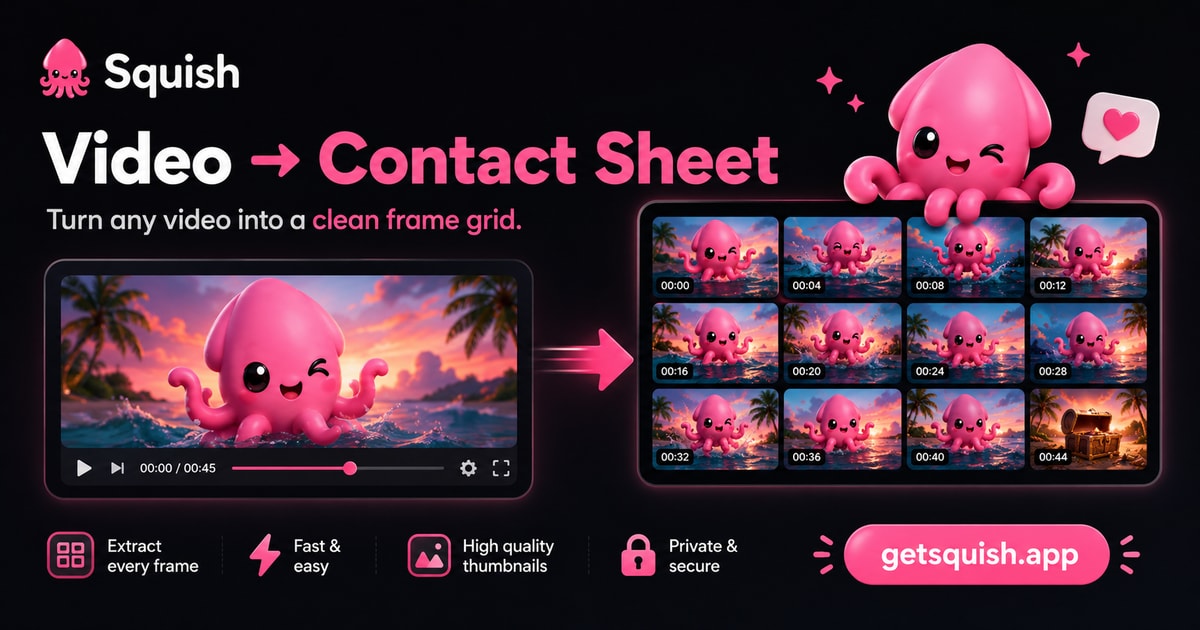
Give AI random access to video. Instead of forcing a model to watch a clip from beginning to end, Squish converts continuous video into an addressable visual representation — one an agent can navigate, revisit, and progressively refine. Timestamped contact sheets are the first implementation of that primitive: a grid of frames, each cell stamped with its absolute timecode. Everything runs on your machine. From the makers of getsquish.app.
Agents don't consume videos — they navigate them. Real run: a scene cut pinned to 0.2 s by retrieving 34 frames — not 3,088 (overview → zoom → zoom).
The demo is the primitive. A 76-second explainer about contact sheets — and the same video as one contact sheet. One needs a play button; the other you just read:
<table> <tr> <td width="50%" align="center" valign="top"> <a href="https://getsquish.app/assets/content/smart-contact-sheets.mp4"> <img src="https://getsquish.app/assets/content/smart-contact-sheets-poster.jpg" alt="How smart contact sheets make video addressable — 76-second explainer video" width="100%"> </a> <br><sub><b>▶ watch — 76 s, linear</b></sub> </td> <td width="50%" align="center" valign="top"> <a href="https://getsquish.app/assets/content/smart-contact-sheets-3x3.jpg"> <img src="https://getsquish.app/assets/content/smart-contact-sheets-3x3.jpg" alt="The same 76-second video as one timestamped 3×3 contact sheet" width="100%"> </a> <br><sub><b>read — one sheet, random access</b></sub> </td> </tr> </table>
Why this works
Video is continuous; reasoning is sparse. Most questions touch a tiny fraction of the timeline. Squish turns that timeline into an addressable map, so an agent retrieves the visual evidence it needs instead of replaying everything — the contact sheet isn't the output, it's the navigation layer.
Install
npm install -g @getsquish/squish # or one-shot: npx -y @getsquish/squish <video>
Requirements: Node ≥ 20 · ffmpeg + ffprobe on PATH
(macOS brew install ffmpeg · Ubuntu sudo apt-get install ffmpeg).
CLI
squish clip.mov                       # sheets land beside the input
squish clip.mov --density 5x5 --json  # denser grid + machine-readable output
squish clip.mov --start 1:00 --end 1:30 --density 5x5   # zoom into a range
Output: <basename>.sheet-N.jpg — a timecoded frame grid. Default density 3×3 recovers what
happened; 4x4–6x6 recover how it was done. --out <dir> picks the destination.
--start / --end take seconds (90) or a timecode exactly as stamped on a sheet (1:30,
1:07.3) and window the run to that range. Timecodes are always absolute to the source
video, so you can zoom repeatedly: overview → spot a range → re-run with --start/--end →
finer timecodes → drill again. Short windows stamp sub-second timecodes (1:07.3) so adjacent
cells stay distinguishable.
With --json, stdout is one object (frozen contract — parse contract to detect breaking
changes):
{
  "input": "/abs/path/clip.mov",
  "duration": 20.275,
  "frames": 9,
  "sheets": 1,
  "files": ["/abs/path/clip.sheet-1.jpg"],
  "warnings": [],
  "contract": "squish-cli-v0"
}
Exit 0 success · 1 failure (message on stderr). Temp frames are always cleaned up.
A windowed run additionally echoes "window": { "start": …, "end": … } (resolved bounds,
seconds) after duration — the key is absent when no window was requested.
MCP server
squish mcp # stdio server
One tool, squish_video — { video_path, density?, start?, end?, out_dir? } → the CLI
contract plus timecodes[][] (one per frame, per sheet; m:ss, sub-second m:ss.d when
a window is short), stamped "contract": "squish-mcp-v0". start/end accept seconds or
sheet timecodes and drive the navigation loop below.
Works with Claude Code, Claude Desktop, Cursor, Hermes, and any stdio MCP client:
{
  "mcpServers": {
    "squish": { "command": "npx", "args": ["-y", "@getsquish/squish", "mcp"] }
  }
}
The navigation loop
- Overview — call
squish_video(MCP) orsquish clip.mov --json(CLI) and read the sheet(s) with vision. Cells run in time order, left→right, top→bottom. - Navigate — spot the regions that matter; every cell carries an absolute timecode.
- Zoom — call again with
start/endset to the timecodes you spotted, only where uncertainty remains: denser sheets of a narrower window, addresses still absolute. - Repeat until the answer is observable — never re-read the whole clip at high density when one range matters.
- Cite absolute timestamps ("at 0:07 the press comes down").
Privacy
The CLI and MCP server process everything on your machine — nothing is uploaded, ever, and every density is free. Want remote processing instead (CI, serverless, no ffmpeg)? There's a hosted API — an intentional upload, prepaid credits, with a free daily allowance for accounts that never purchased.
This repository
This is the engine — the CLI + MCP mouths of Squish, published to npm as
@getsquish/squish. It is a curated,
mirror-first export of a private monorepo (which stays the source of truth); history here
starts at the first public release. See CONTRIBUTING.md for how changes
flow.
Not in this repo, on purpose:
- the getsquish.app web app (PWA) — same core planners, browser hands;
- the hosted API (
api.getsquish.app) — the paid rail: intentional upload, prepaid credits, a free daily allowance for never-paid accounts; - brand assets — the Squish name, logo, mascot, and OG images are reserved.
src/            CLI (main/args) · engine (probe → plan → extract → compose → write) · MCP server · sheet renderer
src/core/       pure planners shared with the web app: density · sampling · grid layout · timecode format
tests/          node:test suite + a real-MCP-client e2e
SKILL.md        drop-in agent skill teaching the contact-sheet + zoom-loop recipe
License
Apache-2.0 (with NOTICE). The Squish name, logo, mascot, and getsquish.app brand assets are not licensed by this repository.
推荐服务器

Baidu Map
百度地图核心API现已全面兼容MCP协议,是国内首家兼容MCP协议的地图服务商。

Playwright MCP Server
一个模型上下文协议服务器,它使大型语言模型能够通过结构化的可访问性快照与网页进行交互,而无需视觉模型或屏幕截图。

Magic Component Platform (MCP)
一个由人工智能驱动的工具,可以从自然语言描述生成现代化的用户界面组件,并与流行的集成开发环境(IDE)集成,从而简化用户界面开发流程。

Audiense Insights MCP Server
通过模型上下文协议启用与 Audiense Insights 账户的交互,从而促进营销洞察和受众数据的提取和分析,包括人口统计信息、行为和影响者互动。

VeyraX
一个单一的 MCP 工具,连接你所有喜爱的工具:Gmail、日历以及其他 40 多个工具。

graphlit-mcp-server
模型上下文协议 (MCP) 服务器实现了 MCP 客户端与 Graphlit 服务之间的集成。 除了网络爬取之外,还可以将任何内容(从 Slack 到 Gmail 再到播客订阅源)导入到 Graphlit 项目中,然后从 MCP 客户端检索相关内容。

Kagi MCP Server
一个 MCP 服务器,集成了 Kagi 搜索功能和 Claude AI,使 Claude 能够在回答需要最新信息的问题时执行实时网络搜索。

e2b-mcp-server
使用 MCP 通过 e2b 运行代码。

Neon MCP Server
用于与 Neon 管理 API 和数据库交互的 MCP 服务器

Exa MCP Server
模型上下文协议(MCP)服务器允许像 Claude 这样的 AI 助手使用 Exa AI 搜索 API 进行网络搜索。这种设置允许 AI 模型以安全和受控的方式获取实时的网络信息。