
the-notebook-mcp
Enables AI agents to directly manipulate Jupyter Notebook cells and structure through a secure, well-defined API, overcoming Cursor's AI agent mode limitations.
README







The Notebook MCP
A Model Context Protocol (MCP) server that enables AI agents to interact with Jupyter Notebook (.ipynb) files. Designed to overcome limitations with Cursor's AI agent mode, this tool allows AI assistants to directly manipulate notebook cells and structure through a secure, well-defined API.
Current Version: 0.9.0 - See the CHANGELOG.md for details on recent changes.
Why Use This?
- For Cursor Users: Enables AI assistants to properly edit, create, and manipulate Jupyter notebooks.
- For Data Scientists: No more copy-pasting AI output manually into your notebooks.
- For Developers: Create complex notebook workflows with AI assistance while maintaining proper notebook structure.
Although originally designed for Cursor, this MCP server can be used with any MCP-compatible AI assistant tool, such as Claude Code.
Quick Start (no install)
# Run (minimal example)
uvx the-notebook-mcp --allow-root /path/to/your/notebooks

# Too see command options...
uvx the-notebook-mcp help
Video Walkthrough
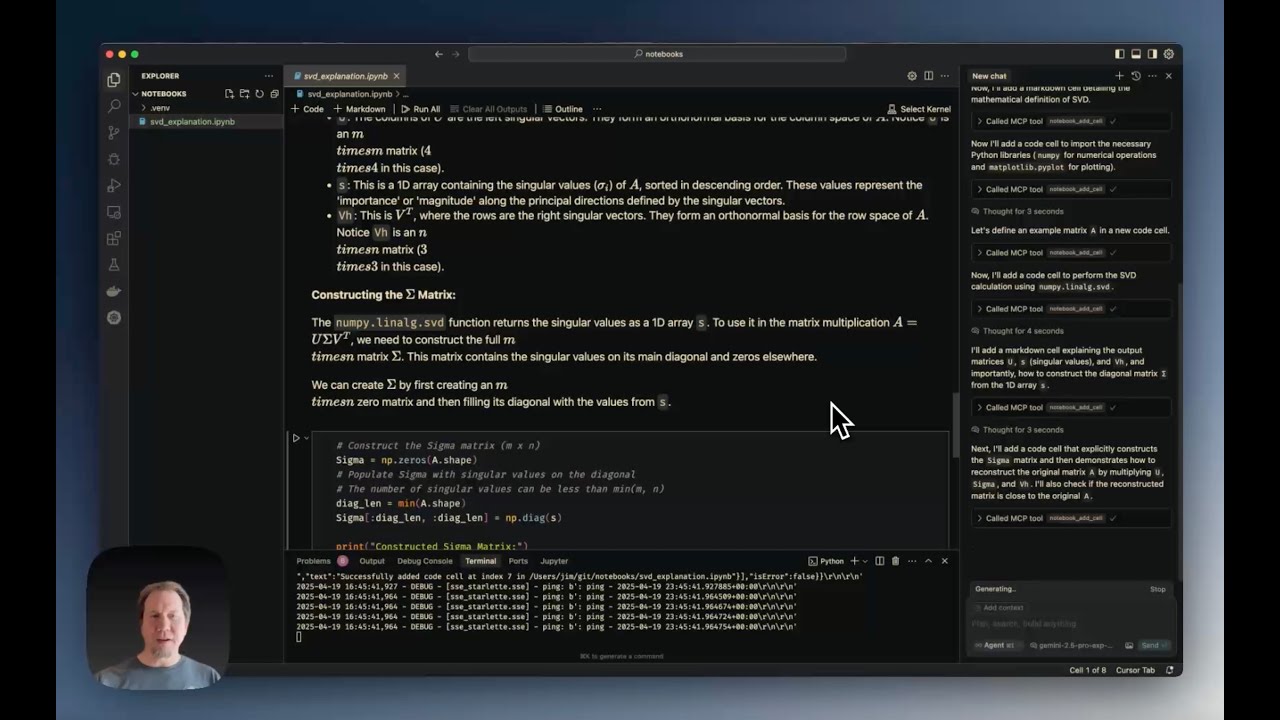
Cursor Jupyter Notebook MCP Server Tutorial demonstrates:
- Installation and configuration
- Creating notebooks from scratch
- Using editing tools (edit, split, duplicate cells)
- Working with notebook metadata
- Exporting notebooks to Python
Features
The server provides the following MCP tools:
File Operations
notebook_create: Creates a new, empty notebook filenotebook_delete: Deletes an existing notebook filenotebook_rename: Renames/moves a notebook file from one path to anothernotebook_export: Exports the notebook to another format (python, html, etc.)notebook_validate: Validates the notebook structure against the nbformat schema
Reading Operations
notebook_read: Reads an entire notebook and returns its structure as a dictionarynotebook_read_cell: Reads the source content of a specific cellnotebook_get_cell_count: Returns the total number of cellsnotebook_get_info: Retrieves general information about the notebooknotebook_get_outline: Generates a structural outline of the notebook (headings, definitions)notebook_search: Searches for a string within all notebook cells
Cell Manipulation
notebook_add_cell: Adds a new code or markdown cellnotebook_edit_cell: Replaces the source content of a specific cellnotebook_delete_cell: Deletes a specific cellnotebook_move_cell: Moves a cell to a different positionnotebook_change_cell_type: Changes a cell's type (code, markdown, or raw)notebook_duplicate_cell: Duplicates a cell multiple timesnotebook_split_cell: Splits a cell into two at a specified line numbernotebook_merge_cells: Merges a cell with the one immediately following itnotebook_execute_cell: Executes a code cell and returns its outputs- Note: Requires an active Jupyter server
- Example:
notebook_execute_cell('/path/to/notebook.ipynb', 1, server_url='http://localhost:8888', token='your-token') - Kernel state is preserved between calls, allowing variables defined in earlier cells to be accessed in later cells
Metadata and Outputs
notebook_read_metadata: Reads the top-level notebook metadatanotebook_edit_metadata: Updates the top-level notebook metadatanotebook_read_cell_metadata: Reads the metadata of a specific cellnotebook_edit_cell_metadata: Updates the metadata of a specific cellnotebook_read_cell_output: Reads the output list of a specific code cellnotebook_clear_cell_outputs: Clears the outputs and execution count of a specific cellnotebook_clear_all_outputs: Clears outputs and execution counts for all code cells
Requirements
Python Dependencies
-
Python Version: ≥ 3.10
-
Core Dependencies: (automatically installed)
fastmcp ≥ 2.3.3nbformat ≥ 5.0nbconvert ≥ 6.0ipythonjupyter_coreloguru ≥ 0.7.3
-
SSE Transport: (install with
uv pip install "the-notebook-mcp[sse]")uvicorn ≥ 0.20.0starlette ≥ 0.25.0
External System Dependencies
For exporting to certain formats, you may need:
- Pandoc: Required for many non-HTML export formats (installation instructions)
- LaTeX: Required for PDF export (installation instructions)
Installation
No Install!
You can run the server directly with
uvx the-notebook-mcp --allow-root $PWD
But if you prefer to install it...
# Basic installation (stdio transport only)
uv tool install the-notebook-mcp

# Using pip
pip install the-notebook-mcp
Development Installation
-
Clone the repository:
git clone https://github.com/svallory/the-notebook-mcp.git cd the-notebook-mcp -
Create and activate a virtual environment:
uv venv source .venv/bin/activate # On Windows use `.venv\Scripts\activate` -
Install in development mode:
uv pip install -e ".[dev]" -
Set up pre-commit hooks (recommended):
pre-commit installSee Pre-commit Hook Setup for details.
Running the Server
Basic Usage
# stdio transport (default)
the-notebook-mcp --allow-root /path/to/notebooks

# SSE transport
the-notebook-mcp --transport sse --allow-root /path/to/notebooks --host 0.0.0.0 --port 8889
Development Mode
Use one of these methods when working with the source code:
# Using poethepoet tasks
uv run poe start

# Using the Python module
python -m the_notebook_mcp.server --allow-root /path/to/notebooks
Available Tasks (poethepoet)
The project includes these predefined tasks:
start: Start the server with default settingscheck-help: Show help informationcheck-version: Show version informationtest: Run the test suite
Example:
# Show help
uv run poe check-help

# Run tests
uv run poe test
Command-Line Arguments
--allow-root: (Required) Path to a directory where notebooks are allowed (can be used multiple times)--transport:stdio(default) orsse--host: Host for SSE transport (default:0.0.0.0)--port: Port for SSE transport (default:8889)--max-cell-source-size: Maximum bytes for cell source (default: 10MB)--max-cell-output-size: Maximum bytes for cell output (default: 10MB)--log-dir: Directory for log files (default:~/.the_notebook_mcp)--log-level:DEBUG,INFO(default),WARNING,ERROR,CRITICAL
Cursor Integration
To configure Cursor to use this server, add settings to ~/.cursor/mcp.json (global) or .cursor/mcp.json (project-specific).
No-Install stdio Transport
[!IMPORTANT] Cursor will expand the
"."argument, but it does not expand"./some/folder".
{
  "mcpServers": {
    "the-notebook-mcp": {
      "command": "uvx",
      "args": [
        "the-notebook-mcp",
        "start",
        "--allow-root",
        "."
      ]
    }
  }
}
stdio Transport
{
  "mcpServers": {
    "the-notebook-mcp": {
      "command": "the-notebook-mcp",
      "args": [
        "start",
        "--allow-root",
        "."
      ]
    }
  }
}
SSE Transport (Recommended)
[!NOTE] You'll need to run the server separately
{
  "mcpServers": {
    "notebook_mcp": {
      "url": "http://127.0.0.1:8889/sse"
    }
  }
}
Limitations and Security
- Security Measures:
- Paths are restricted to allowed root directories
- Size limits on cell sources and outputs
- Input validation for file extensions and types
Development & Testing
# Setup
uv venv
source .venv/bin/activate
uv pip install -e ".[dev]"
pre-commit install

# Testing
uv run poe test
Known Issues
- UI Refresh Issues: Some operations may succeed at the file level, but the Cursor UI might not update immediately. To fix, close and reopen the notebook or choose "Revert" when prompted.
Contributing
Contributions are welcome! Please:
- Fork the repository
- Create a feature branch
- Make your changes with tests
- Submit a pull request
See GitHub Issues for existing bugs or feature requests.
Acknowledgments
This project is based on the work of Jim Beno in cursor-notebook-mcp.
License
This project is licensed under the MIT License. See the LICENSE file for details.
Author
Maintained by Saulo Vallory.
推荐服务器

Baidu Map
百度地图核心API现已全面兼容MCP协议,是国内首家兼容MCP协议的地图服务商。

Playwright MCP Server
一个模型上下文协议服务器,它使大型语言模型能够通过结构化的可访问性快照与网页进行交互,而无需视觉模型或屏幕截图。

Magic Component Platform (MCP)
一个由人工智能驱动的工具,可以从自然语言描述生成现代化的用户界面组件,并与流行的集成开发环境(IDE)集成,从而简化用户界面开发流程。

Audiense Insights MCP Server
通过模型上下文协议启用与 Audiense Insights 账户的交互,从而促进营销洞察和受众数据的提取和分析,包括人口统计信息、行为和影响者互动。

VeyraX
一个单一的 MCP 工具,连接你所有喜爱的工具:Gmail、日历以及其他 40 多个工具。

graphlit-mcp-server
模型上下文协议 (MCP) 服务器实现了 MCP 客户端与 Graphlit 服务之间的集成。 除了网络爬取之外,还可以将任何内容(从 Slack 到 Gmail 再到播客订阅源)导入到 Graphlit 项目中,然后从 MCP 客户端检索相关内容。

Kagi MCP Server
一个 MCP 服务器,集成了 Kagi 搜索功能和 Claude AI,使 Claude 能够在回答需要最新信息的问题时执行实时网络搜索。

e2b-mcp-server
使用 MCP 通过 e2b 运行代码。

Neon MCP Server
用于与 Neon 管理 API 和数据库交互的 MCP 服务器

Exa MCP Server
模型上下文协议(MCP)服务器允许像 Claude 这样的 AI 助手使用 Exa AI 搜索 API 进行网络搜索。这种设置允许 AI 模型以安全和受控的方式获取实时的网络信息。