
Yandex Reverse Image Search MCP Server
Enables reverse image search using Yandex via Apify, returning structured JSON with matching pages, similar images, and more.
README
🔎 Yandex Reverse Image Search API: search by image, get structured JSON
The most efficient, reliable, and developer-friendly way to use the Yandex Reverse Image Search API.
Actor page: apify.com/johnvc/yandex-reverse-image-search Input schema: apify.com/johnvc/yandex-reverse-image-search/input-schema
Search by image instead of by keywords. Give this reverse image search API the public URL of any image and it searches Yandex's reverse image engine (the same one behind yandex.com/images) to find every page where the image appears online, visually similar images, other sizes and resolutions of the same image, products that match the image, and descriptive tags. Every result is one JSON row tagged with a result_type field, so you can filter and route the data straight into your own code. Pay per result, with a hard cap you control.
Video Walkthrough

Quick Start
Prerequisites
- Python 3.11 or higher
- An Apify account and API key (get a free key here)
-
Clone the repository
git clone https://github.com/johnisanerd/Apify-Yandex-Reverse-Image-Search-API.git cd Apify-Yandex-Reverse-Image-Search-API -
Install dependencies with UV
# Install UV if you do not have it: curl -LsSf https://astral.sh/uv/install.sh | sh # Install project dependencies: uv sync -
Configure your API key
cp .env.example .env # Edit .env and add your Apify API key # Get your free API key at: https://apify.com?fpr=9n7kx3 -
Run the example
uv run python yandex-reverse-image-search-api-example.py
Alternative: set the API key directly
export APIFY_API_TOKEN="your_api_key_here"
uv run python yandex-reverse-image-search-api-example.py
Why Use This Reverse Image Search API?
Search by image, not by keyword. A normal image search takes words and returns pictures. This reverse image search API does the opposite: you hand it a picture and it returns where that picture appears online, what looks similar to it, and what is in it. That is the difference between guessing a caption and asking the web directly.
Yandex coverage as a clean API. Yandex is widely regarded as one of the strongest reverse image engines on the web, especially for faces, places, and content that Western engines miss. This actor gives you that reach as a typed JSON endpoint, no HTML, no tokens, no blocking to manage on your side.
One row per result, tagged and filterable. Every result comes back as a single dataset row with a result_type field, so you can split matching pages from similar images from shopping matches in one pass and send each type where it belongs.
Cost you control. Billing is one charge per result row. You decide which result types to turn on and set a max_results cap, so a first run can be a few cents and a monitoring run can be tightly bounded.
Built for automation and source hunting. Save an image as a task, put it on a schedule, and re-check Yandex for new copies over time. It is a practical base for brand protection, counterfeit detection, image provenance work, and source hunting, tracing a compressed or cropped image back to its original.
Features
Core Capabilities
- Search by any public image URL and get every page where the image appears, with title, link, snippet, and source.
- Retrieve visually similar images from across the web, with thumbnails and full-size links.
- Optional result types: other resolutions of the same image, descriptive image tags, matching shop products with prices, and a knowledge-graph entity card.
- Crop-box targeting: search only part of an image (one face in a group photo, one product on a shelf).
- Six regional Yandex domains (yandex.com, yandex.ru, yandex.by, yandex.kz, yandex.uz, yandex.com.tr).
Data Quality
- Structured JSON with a
result_typetag on every row for easy filtering. - A
max_resultscap that bounds both the rows returned and the amount billed. - Consistent fields (title, link, source, original, thumbnail, search timestamp) across matching pages and similar images.
Usage Examples
Basic Example
{
  "image_url": "https://example.com/product.jpg",
  "max_results": 20
}
Advanced Example
{
  "image_url": "https://example.com/group-photo.jpg",
  "crop": "0.1;0.2;0.5;0.8",
  "include_matching_pages": true,
  "include_similar_images": true,
  "include_shopping_results": true,
  "yandex_domain": "yandex.ru",
  "max_results": 100
}
Input Parameters
| Parameter | Type | Required | Default | Description |
|---|---|---|---|---|
image_url |
str |
YES | - | Public http(s) URL of the image to search by. Yandex fetches it, so it must be reachable from the internet (direct image link, no login or redirect). |
crop |
str |
no | (none) | Search only part of the image: four ;-separated fractions 0-1 in the order left;top;right;bottom, e.g. 0.1;0.2;0.9;0.8. |
include_matching_pages |
bool |
no | true |
Pages where the image appears online (result_type matching_page). |
include_similar_images |
bool |
no | true |
Visually similar images (result_type similar_image). |
include_image_sizes |
bool |
no | false |
Other resolutions of the same image (result_type image_size). |
include_image_tags |
bool |
no | false |
Descriptive tags for the image content (result_type image_tag). |
include_shopping_results |
bool |
no | false |
Matching products with prices (result_type shopping_result). |
include_knowledge_graph |
bool |
no | false |
Entity card for recognizable subjects (result_type knowledge_graph). |
yandex_domain |
str |
no | yandex.com |
Regional domain: yandex.com, yandex.ru, yandex.by, yandex.kz, yandex.uz, yandex.com.tr. |
max_results |
int |
no | 0 |
Hard cap on rows returned and billed. 0 = everything found. Set 20 for a cheap first run. |
Output Format
Each result is one dataset row tagged with a result_type. A matching_page row looks like this:
{
  "result_type": "matching_page",
  "position": 27,
  "title": "Central Illustration Agency Illustration portfolio: Matt Taylor",
  "link": "https://tr.pinterest.com/pin/matt-taylor-digital-illustration-illustrator-graphic-poster-art-car-scenery-bold--826762444071832079/",
  "thumbnail": "https://avatars.mds.yandex.net/i?id=592d913ed53e1f78fdd0804bd7064417b709bafb-5437458-images-thumbs&n=13&w=296&h=180",
  "original": "https://i.pinimg.com/736x/9e/b1/f7/9eb1f76ee45eb01706be89b8748a911b.jpg",
  "source": "tr.pinterest.com",
  "snippet": "After graduating from Buckinghamshire University he rolled straight into a successful ten year illustration career.",
  "image_url": "https://substack-post-media.s3.amazonaws.com/public/images/edbfb2cd-ebcb-4527-bec7-5315c182278f_445x445.png",
  "yandex_domain": "yandex.com",
  "crop": "",
  "search_timestamp": "2026-07-05T12:00:00"
}
Every row also carries the query image URL, the Yandex domain used, the crop box (if any), and a search timestamp.
<!-- The five install sections below come verbatim from the canonical MCP install copy. Each embeds a hosted screenshot from ApifyPublicData/assets/guides (no local screenshots/ folder). -->
Install in Claude Cowork Desktop
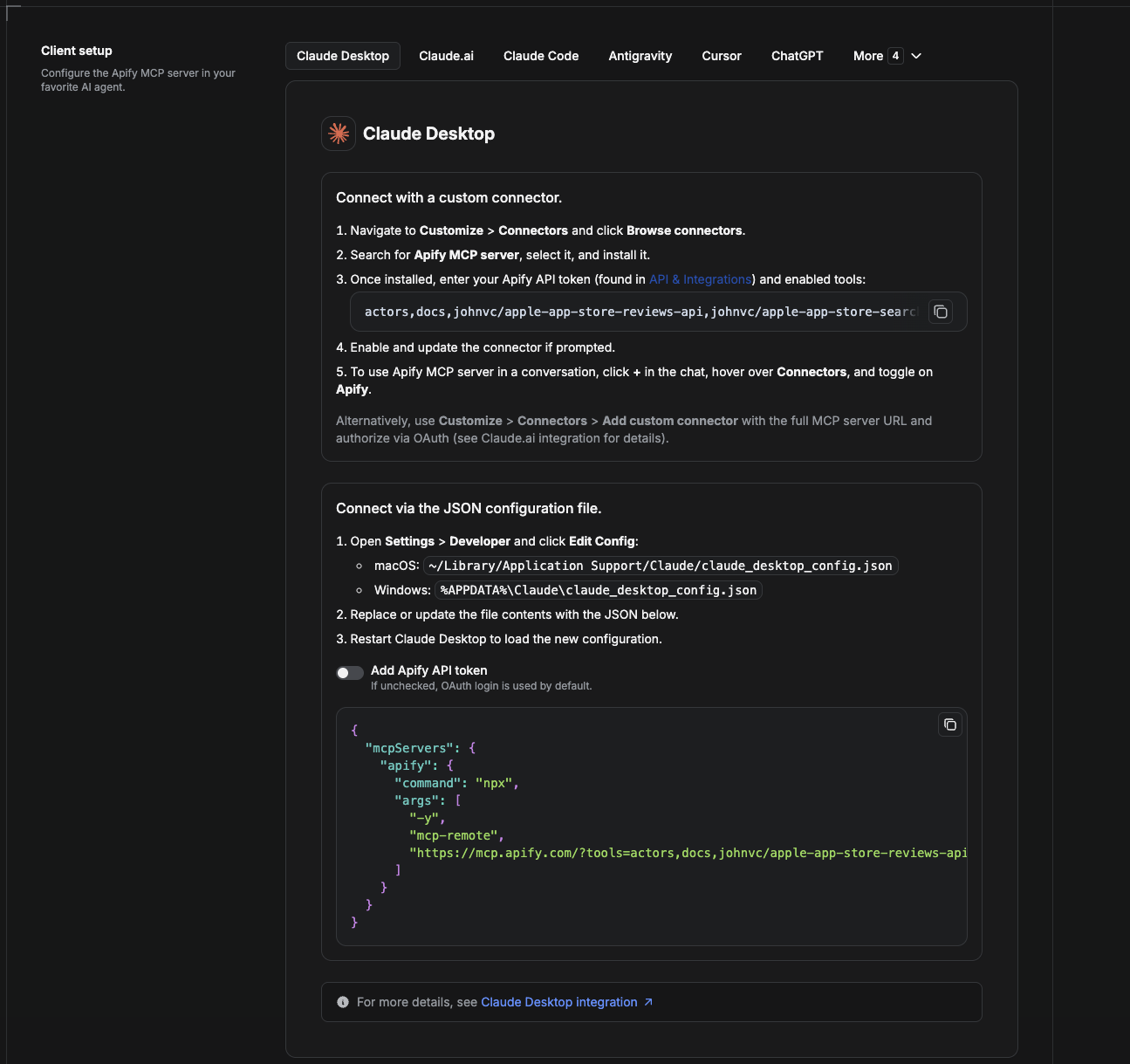
Cowork is the desktop app's automation mode. To give it the Yandex Reverse Image Search API as a tool, add the Apify MCP server as a connector.
- Open the Claude desktop app and go to Settings → Connectors (or Settings → Developer → Edit Config to edit
claude_desktop_config.jsondirectly).- macOS:
~/Library/Application Support/Claude/claude_desktop_config.json - Windows:
%APPDATA%\Claude\claude_desktop_config.json
- macOS:
- Add the Apify MCP server, preloaded with only this Actor:
{
  "mcpServers": {
    "apify": {
      "command": "npx",
      "args": [
        "-y",
        "mcp-remote",
        "https://mcp.apify.com/?tools=actors,docs,johnvc/yandex-reverse-image-search"
      ]
    }
  }
}
- Restart the app. When Cowork first calls the tool, complete the OAuth prompt in your browser, or add your Apify API token in the connector settings to skip OAuth.
- In a Cowork chat, confirm the tool is available and ask it to run the Yandex Reverse Image Search API.
Download the desktop app and start a free trial: https://claude.ai/referral/uIlpa7nPLg More help: https://docs.apify.com/platform/integrations/claude-desktop
Install in Claude Code
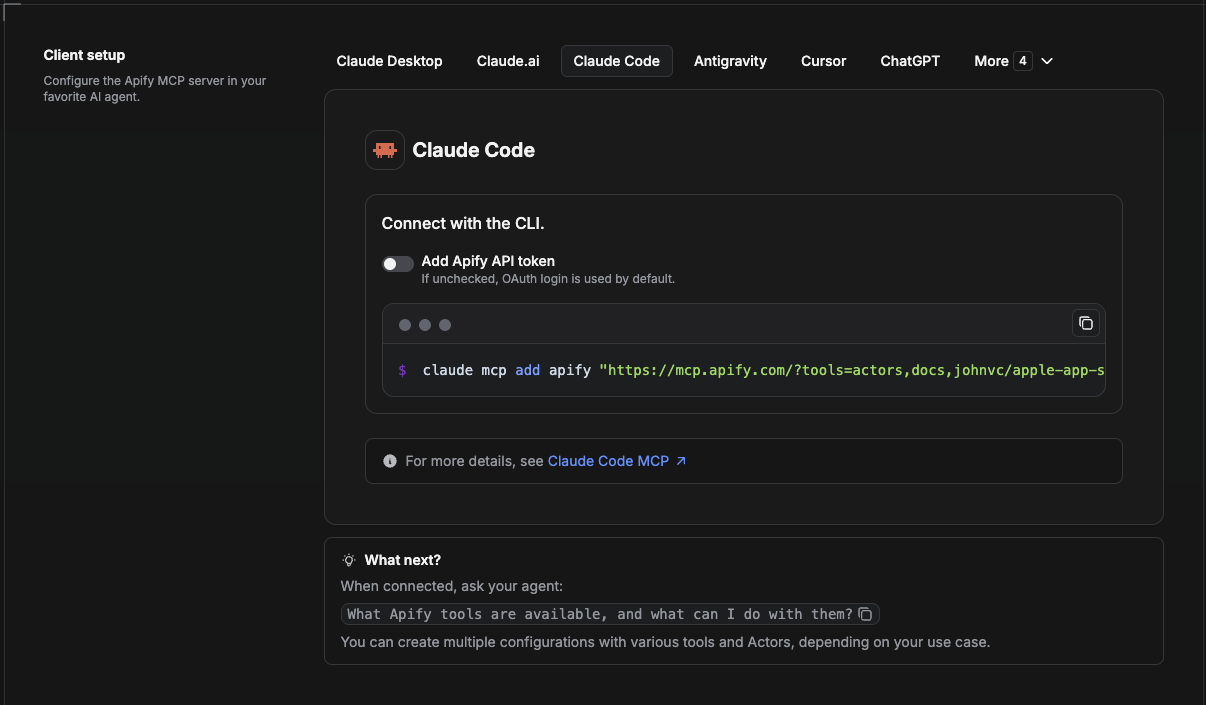
Claude Code is the command-line tool. Add the Actor's MCP server with one command:
claude mcp add --transport http apify \
  "https://mcp.apify.com/?tools=actors,docs,johnvc/yandex-reverse-image-search"
To use a token instead of browser OAuth:
claude mcp add --transport http apify \
  "https://mcp.apify.com/?tools=actors,docs,johnvc/yandex-reverse-image-search" \
  --header "Authorization: Bearer YOUR_APIFY_TOKEN"
Then verify with claude mcp list, or run /mcp inside a session. Ask Claude Code to call the Yandex Reverse Image Search API.
Try Claude Code free: https://claude.ai/referral/uIlpa7nPLg Claude Code MCP docs: https://code.claude.com/docs/en/mcp
Install in Claude (website)
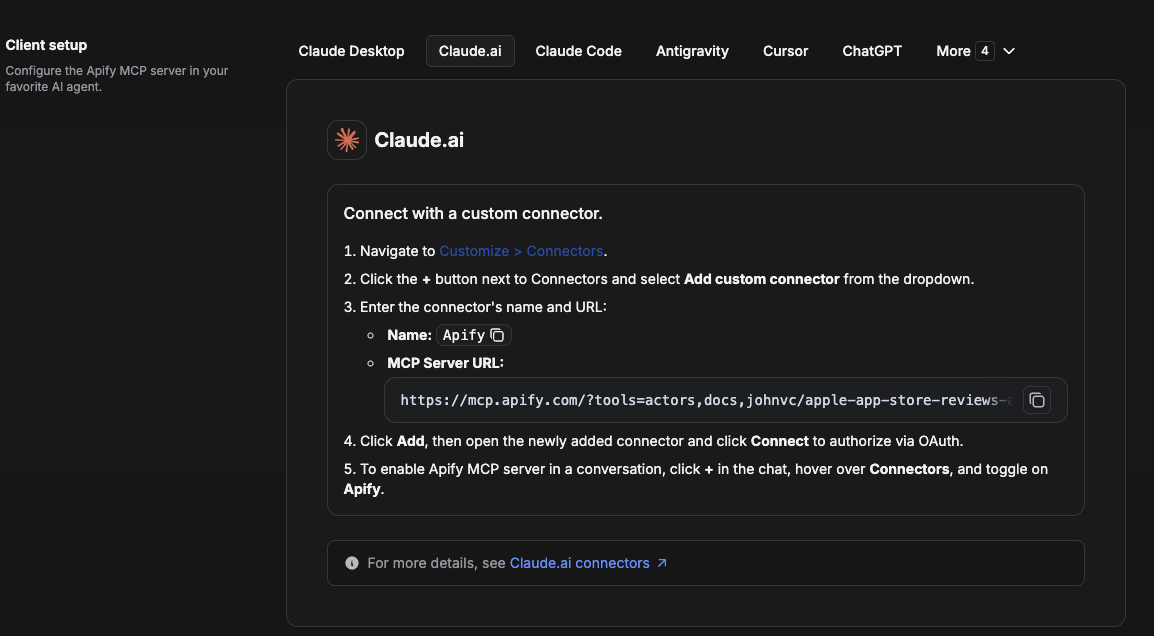
On claude.ai you add Apify as a connector, then enable just this Actor's tool.
- Go to Settings → Connectors → Browse connectors and search for Apify MCP server. Install it (enable or update if prompted).
- When connecting, authenticate with your Apify API token, and enable the tool
johnvc/yandex-reverse-image-search. - In any chat, open + → Connectors and turn on Apify.
- Alternatively, choose Add custom connector and paste the full MCP URL
https://mcp.apify.com/?tools=actors,docs,johnvc/yandex-reverse-image-search, using OAuth when prompted. - Ask Claude to run the Yandex Reverse Image Search API.
Open Claude on the web: https://claude.ai
Install in Cursor
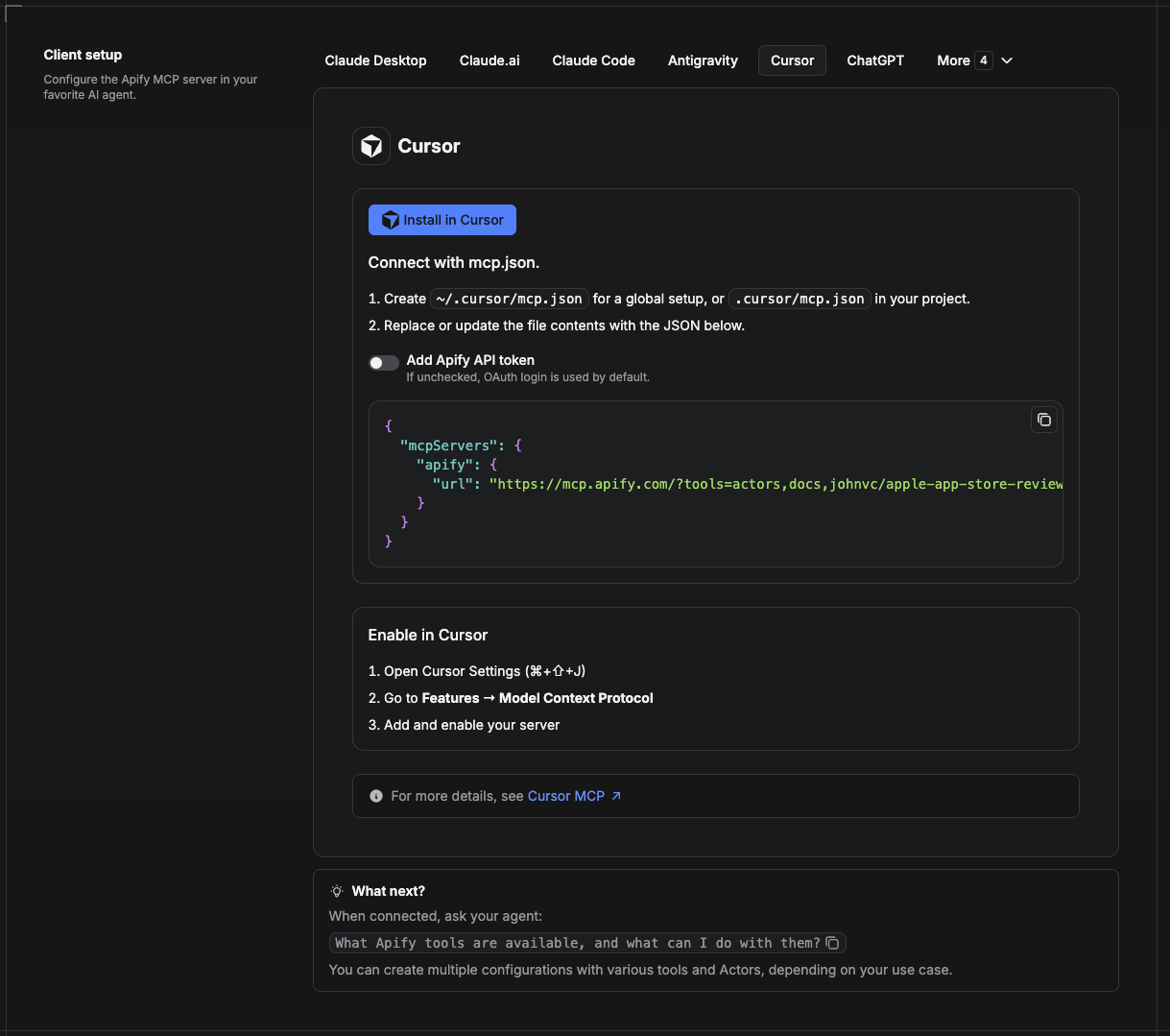
Cursor reads MCP servers from a project file at .cursor/mcp.json.
- In your project, create
.cursor/mcp.json:
{
  "mcpServers": {
    "apify": {
      "url": "https://mcp.apify.com/?tools=actors,docs,johnvc/yandex-reverse-image-search"
    }
  }
}
- If you prefer token auth over browser OAuth, add a header:
{
  "mcpServers": {
    "apify": {
      "url": "https://mcp.apify.com/?tools=actors,docs,johnvc/yandex-reverse-image-search",
      "headers": { "Authorization": "Bearer YOUR_APIFY_TOKEN" }
    }
  }
}
- Open Cursor → Settings → MCP and confirm the apify server is connected (green dot).
- In Composer or Chat, ask Cursor to call the Yandex Reverse Image Search API.
New to Cursor? Get it here: https://cursor.com/referral?code=XQP4VBLI3NNX
Install in ChatGPT
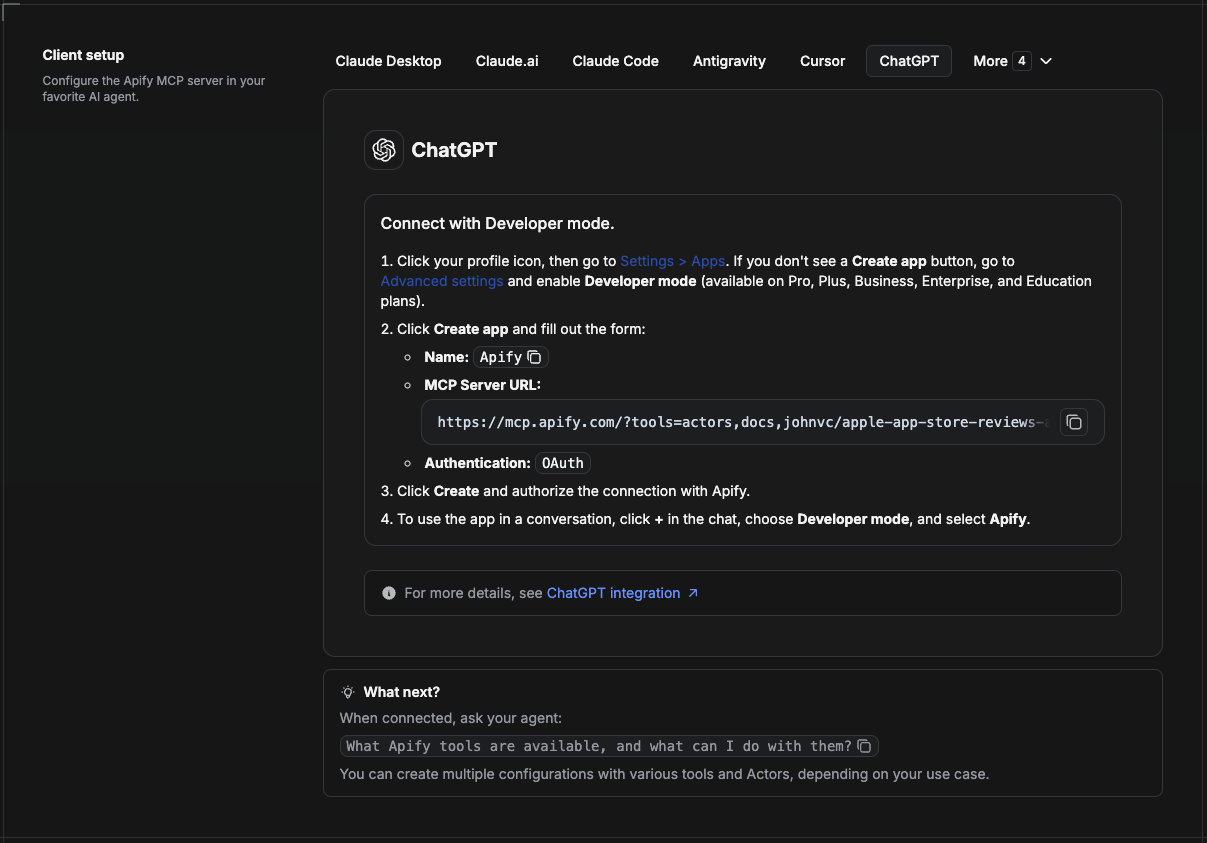
ChatGPT connects to the Apify MCP server through Developer mode (available on ChatGPT Pro, Plus, Business, Enterprise, and Education plans).
- Click your profile icon, then go to Settings > Apps. If you do not see a Create app button, open Advanced settings and enable Developer mode.
- Click Create app and fill out the form:
- Name: Apify
- MCP Server URL:
https://mcp.apify.com/?tools=actors,docs,johnvc/yandex-reverse-image-search - Authentication: OAuth
- Click Create and authorize the connection with Apify.
- To use the app in a conversation, click + in the chat, choose Developer mode, and select Apify.
More help: https://docs.apify.com/platform/integrations/mcp
Use the Yandex Reverse Image Search API to power your image monitoring, brand protection, and source hunting workflows with reliable, structured results.
Last Updated: 2026.07.11
推荐服务器

Baidu Map
百度地图核心API现已全面兼容MCP协议,是国内首家兼容MCP协议的地图服务商。

Playwright MCP Server
一个模型上下文协议服务器,它使大型语言模型能够通过结构化的可访问性快照与网页进行交互,而无需视觉模型或屏幕截图。

Magic Component Platform (MCP)
一个由人工智能驱动的工具,可以从自然语言描述生成现代化的用户界面组件,并与流行的集成开发环境(IDE)集成,从而简化用户界面开发流程。

Audiense Insights MCP Server
通过模型上下文协议启用与 Audiense Insights 账户的交互,从而促进营销洞察和受众数据的提取和分析,包括人口统计信息、行为和影响者互动。

VeyraX
一个单一的 MCP 工具,连接你所有喜爱的工具:Gmail、日历以及其他 40 多个工具。

graphlit-mcp-server
模型上下文协议 (MCP) 服务器实现了 MCP 客户端与 Graphlit 服务之间的集成。 除了网络爬取之外,还可以将任何内容(从 Slack 到 Gmail 再到播客订阅源)导入到 Graphlit 项目中,然后从 MCP 客户端检索相关内容。

Kagi MCP Server
一个 MCP 服务器,集成了 Kagi 搜索功能和 Claude AI,使 Claude 能够在回答需要最新信息的问题时执行实时网络搜索。

e2b-mcp-server
使用 MCP 通过 e2b 运行代码。

Neon MCP Server
用于与 Neon 管理 API 和数据库交互的 MCP 服务器

Exa MCP Server
模型上下文协议(MCP)服务器允许像 Claude 这样的 AI 助手使用 Exa AI 搜索 API 进行网络搜索。这种设置允许 AI 模型以安全和受控的方式获取实时的网络信息。