
fenestra-mcp
MCP server for fenestra, a pure-Rust native GUI framework. Renders and verifies native UIs headlessly (no display, no GPU): a typed accessibility tree, semantic query/interact, contrast/focus-order/hit-target checks, screenshot diffing, and motion filmstrips.
README
fenestra




A pure-Rust native GUI framework with web-grade aesthetics — and first-class headless rendering, so both humans and AI coding agents can see what they build.
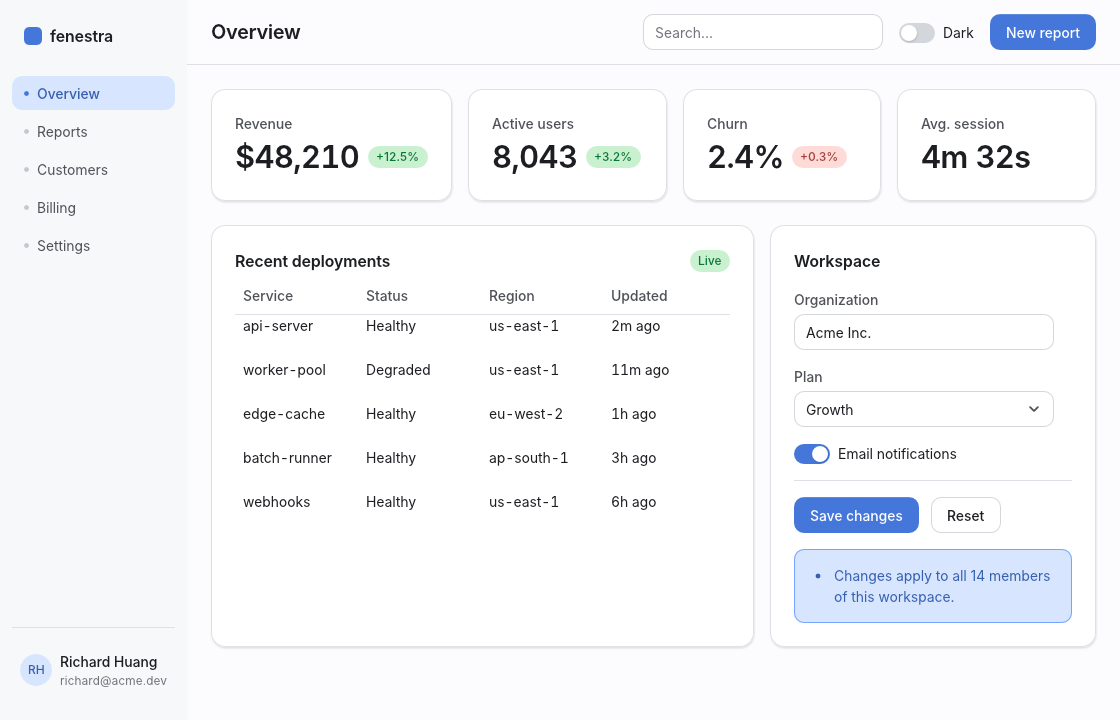
▶ Try the live demo — the dashboard and widget galleries running in your browser via WebGPU. No DOM, no CSS: every pixel is vello on wgpu, the same code as the native window. Read the book for the guided tour.
| Light | Dark |
|---|---|
 |
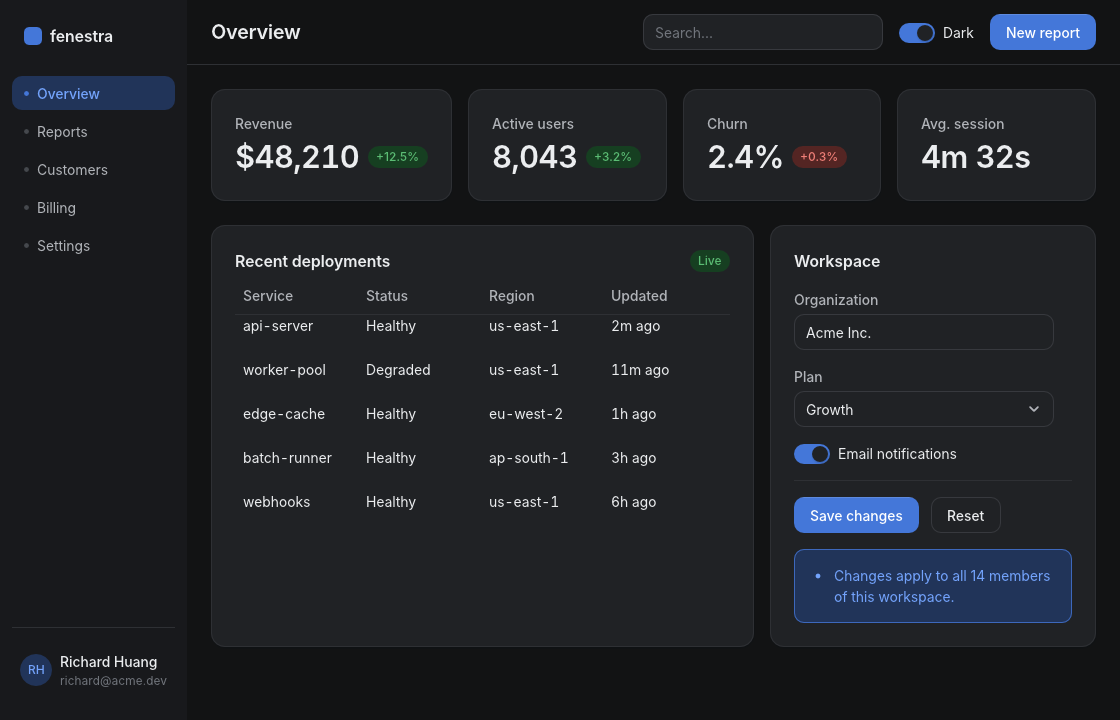 |
No browser. No webview. No HTML or CSS parser. fenestra draws everything itself with vello on wgpu, lays out with taffy (flexbox + grid), shapes text with parley, and ships a themed widget kit that looks like a polished modern web app: layered soft shadows, OKLCH color ramps, real typographic hierarchy, hover/focus transitions, and first-class light and dark themes.
Quickstart
use fenestra::prelude::*;

struct Counter { n: i64 }

#[derive(Clone)]
enum Msg { Inc, Dec }

impl App for Counter {
    type Msg = Msg;

    fn update(&mut self, msg: Msg) {
        match msg { Msg::Inc => self.n += 1, Msg::Dec => self.n -= 1 }
    }

    fn view(&self) -> Element<Msg> {
        col().p(SP6).gap(SP4).items_center().children([
            text(self.n.to_string()).size(TextSize::Xl2).weight(Weight::Semibold),
            row().gap(SP3).children([
                button("Decrement").variant(ButtonVariant::Secondary).on_click(Msg::Dec),
                button("Increment").on_click(Msg::Inc),
            ]),
        ])
    }
}

fn main() { fenestra::run(Counter { n: 0 }, WindowOptions::titled("Counter")) }
cargo add fenestra, paste, cargo run. Or start from the template —
cargo generate richer-richard/fenestra-template — which includes a
headless UI test and CI. The whole view is rebuilt, laid out, and
repainted on every redraw — no diffing, no macros, everything
autocompletes.
Agents can see what they build
Rendering (element tree, theme, size) to pixels is a pure function, and it
runs without a window or display server:
use fenestra::shell::{SyntheticEvent, render_app, render_element};

// A picture of any element tree:
let image = render_element(my_view(), &Theme::dark(), (800, 600));
image.save("preview.png")?;

// Or drive a full app with scripted input and look at the result:
let image = render_app(
    &mut app,
    &[
        SyntheticEvent::MouseMove { x: 50.0, y: 34.0 },
        SyntheticEvent::MouseDown,
        SyntheticEvent::MouseUp,
        SyntheticEvent::Text("hello".into()),
    ],
    (800, 600),
    &Theme::light(),
);
assert_eq!(app.value, "hello");
Headless rendering is deterministic (embedded fonts, fixed scale, reduced motion), which makes pixel-exact golden tests practical — fenestra's own widget kit is tested this way, on CI, with no GPU display attached.
The same pipeline backs a JSON authoring format, fenestra/1, for agents and
tools that don't want to compile Rust: describe a UI — now including an
image node and fourteen widgets that used to be code-only (data tables,
trees, popovers, command palettes, the OKLCH color picker, and more) — and
fenestra-describe parses it into the identical
Element tree the builders above produce. fenestra render renders it,
fenestra preview <file> opens a live-reload window that re-renders on
every save, and the fenestra-mcp server exposes the whole
loop — render, query, interact, verify — as thirteen MCP tools. Motion is
watchable too, not just single frames: Harness::film (or fenestra film,
or the MCP film_ui tool) captures a sequence with real motion turned on and
composes it into one captioned filmstrip.
The verification envelope, stated plainly. A headless render is a deliberate subset of the live window — that subset is what makes it deterministic — so trust it accordingly. It uses the embedded fonts (Inter covers Latin; the real monospace, CJK, emoji, and RTL faces come from the OS and so appear only in a real window), forces reduced motion, and is referenced against one GPU backend (macOS/Metal; Linux/lavapipe within a wider tolerance). The full Liquid-Glass optics — backdrop blur, edge lensing, adaptive vibrancy — render only in the headless/golden path; the live single-pass window shows the translucent tint plus the specular rim and sheen. So headless is the right oracle for layout, semantics, color, and the large majority of pixels — but confirm non-Latin/monospace text and full glass in a window. On the web target, AccessKit, the OS clipboard, and the glass passes are compiled out.
Working with an AI agent? AGENTS.md is the manual for the build → render → look → verify loop (and llms.txt for context loaders).
Philosophy: web aesthetics without the web platform
The web's look — soft elevation, tinted neutrals, OKLCH ramps, 4px-grid
spacing, focus rings, 120–300ms easing — is the best-tested visual language
in software. The web platform is a heavy way to get it. fenestra encodes
that language as typed Rust values: a Theme generated from one accent hue,
spacing/radius/shadow/motion tokens, and a builder vocabulary (row(),
.p(SP4), .rounded(R_MD), .shadow(ShadowToken::Sm)) small enough to
memorize and regular enough for rust-analyzer (or a language model) to
autocomplete. Every widget routes every color through the theme; flip one
Mode and the whole app is dark.
The kit
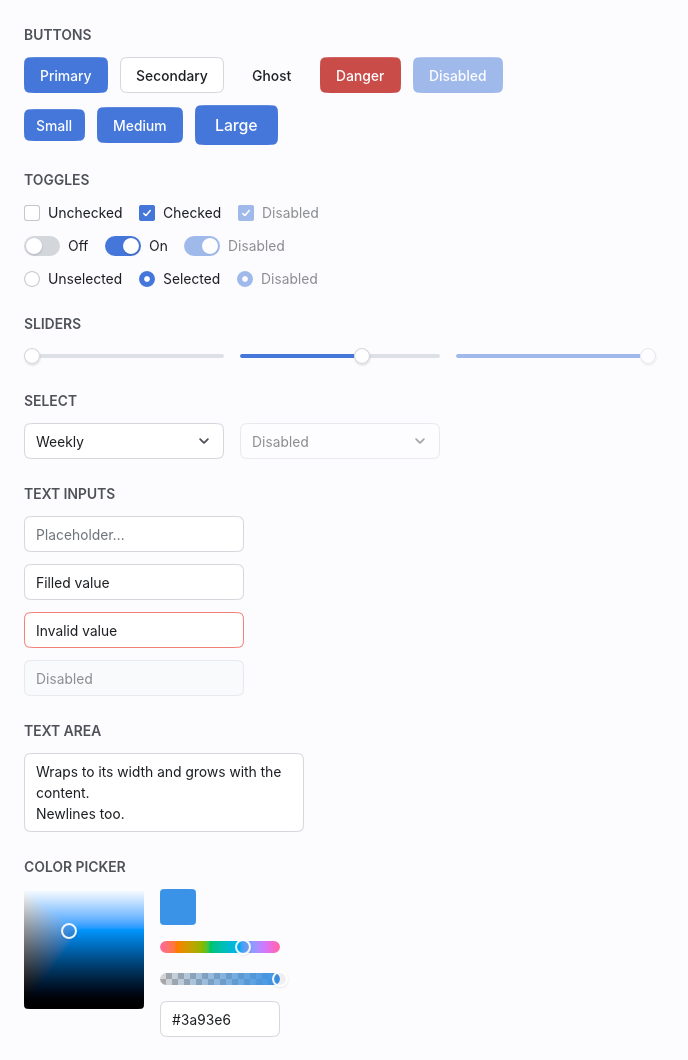
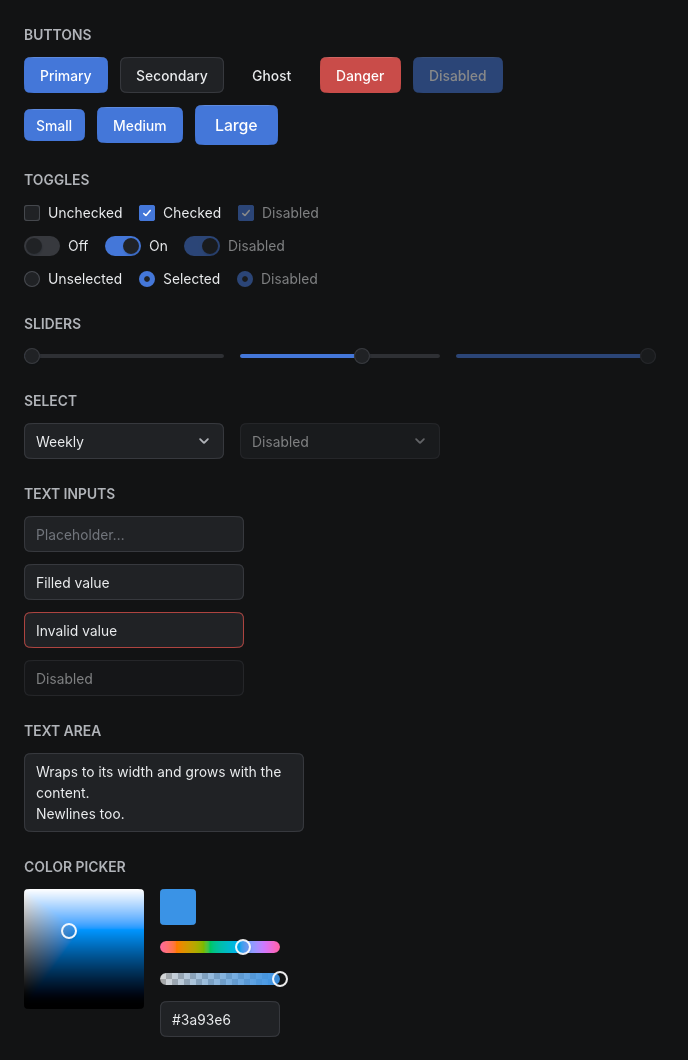
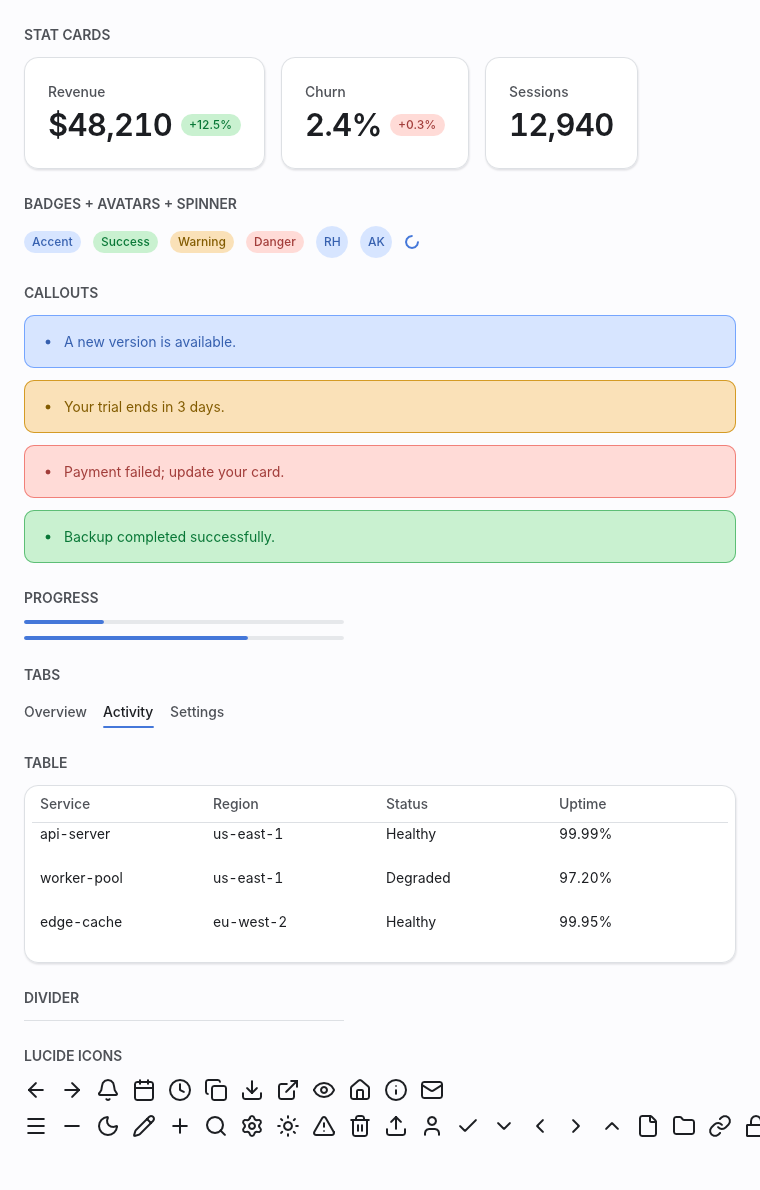
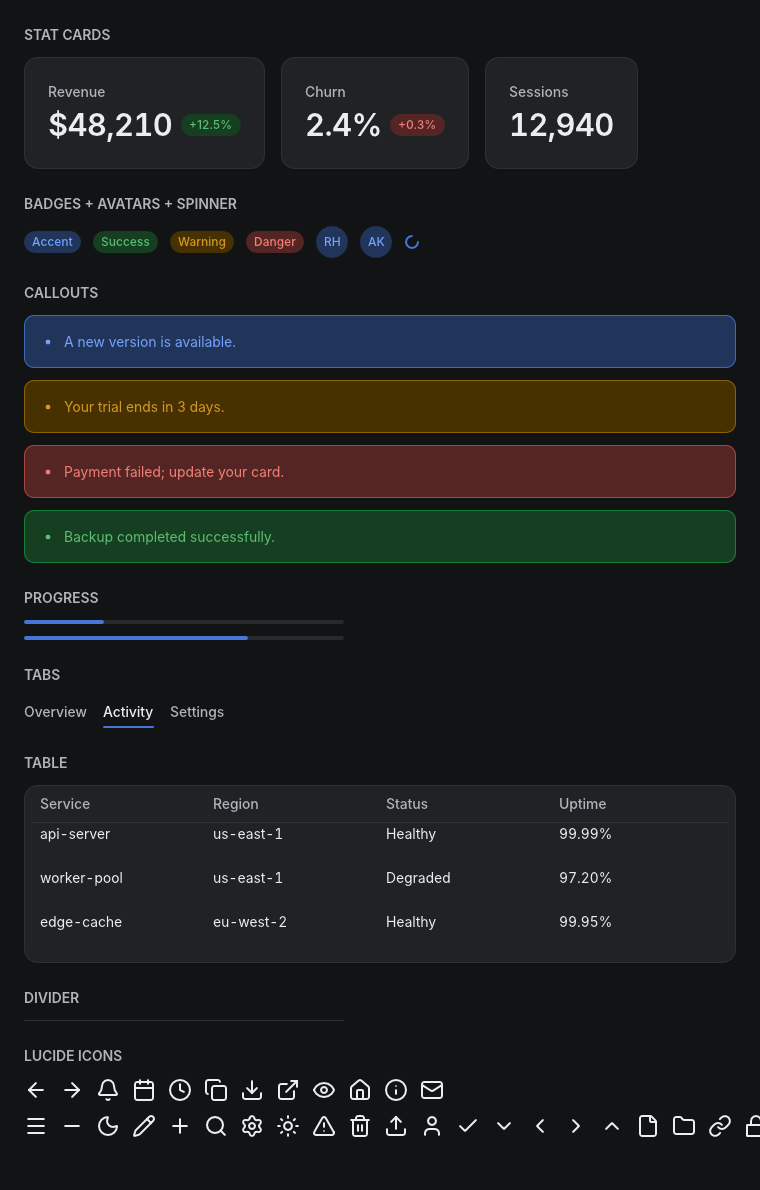
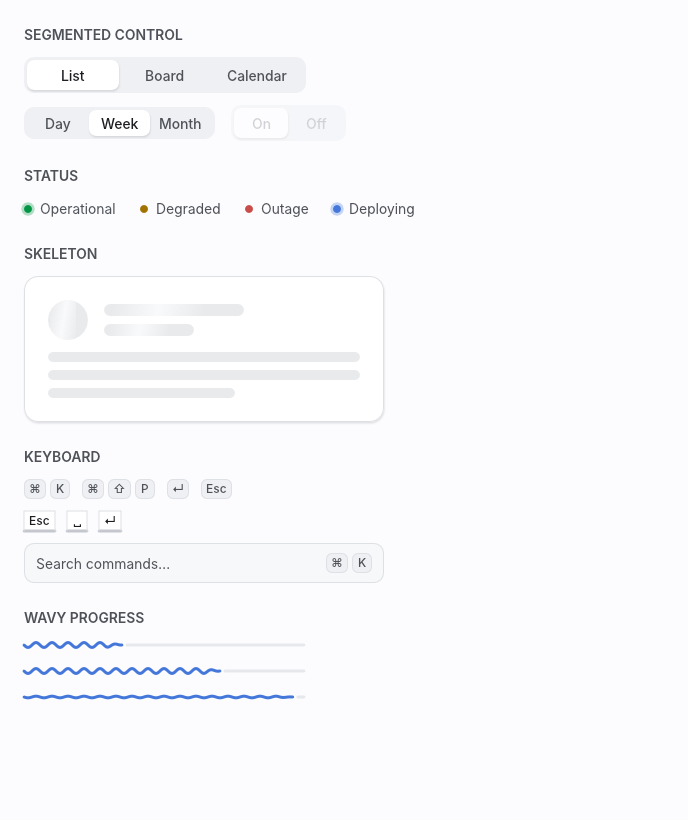
Button, IconButton, Checkbox, Switch, Radio, Slider, Color Picker (OKLCH lightness×chroma pad, hue/alpha strips, forgiving hex entry), SegmentedControl, TextInput (parley editing, clipboard, IME), TextArea (multiline, auto-growing), Select, Tooltip, Modal (focus trap + backdrop), Toasts, Tabs, Card, StatCard, Badge, Avatar, StatusIndicator (with a live pulse), Kbd key-caps, Skeleton loaders, Divider, Progress (including a Material-3 Expressive wavy bar), Spinner, Table, Callout, and a vendored Lucide icon subset — every state, both themes:
 |
 |
 |
 |
 |
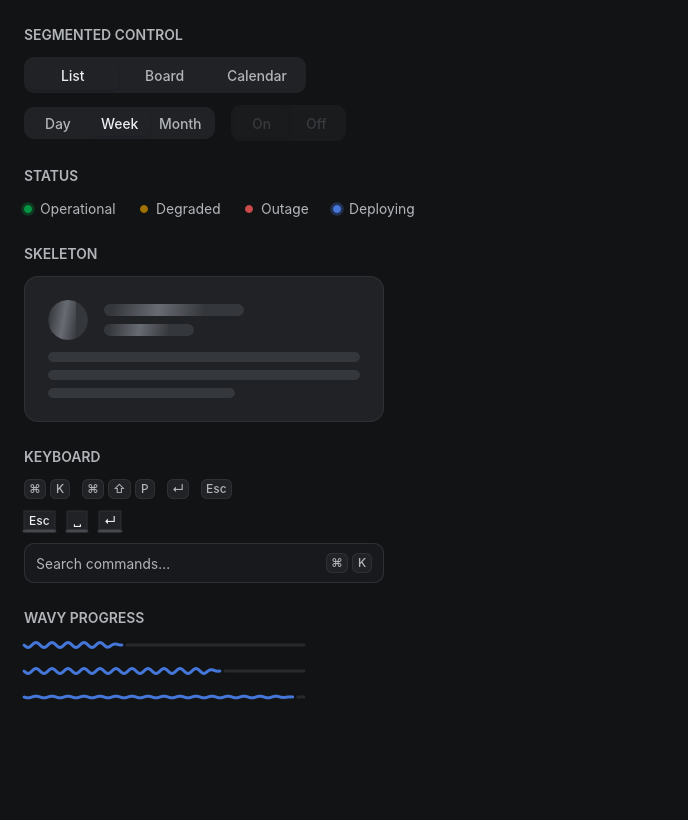 |
Regenerate this corpus any time with cargo run --example gallery — it
renders headlessly.
Motion
fenestra-motion renders frame-pure compositions headlessly — no live
window, no screen recorder — and the same pipeline is what fenestra film
and the MCP film_ui tool use to let an agent watch a transition play. A
fenestra-charts bar chart, rebuilt every frame from rank-sorted,
track-interpolated data:
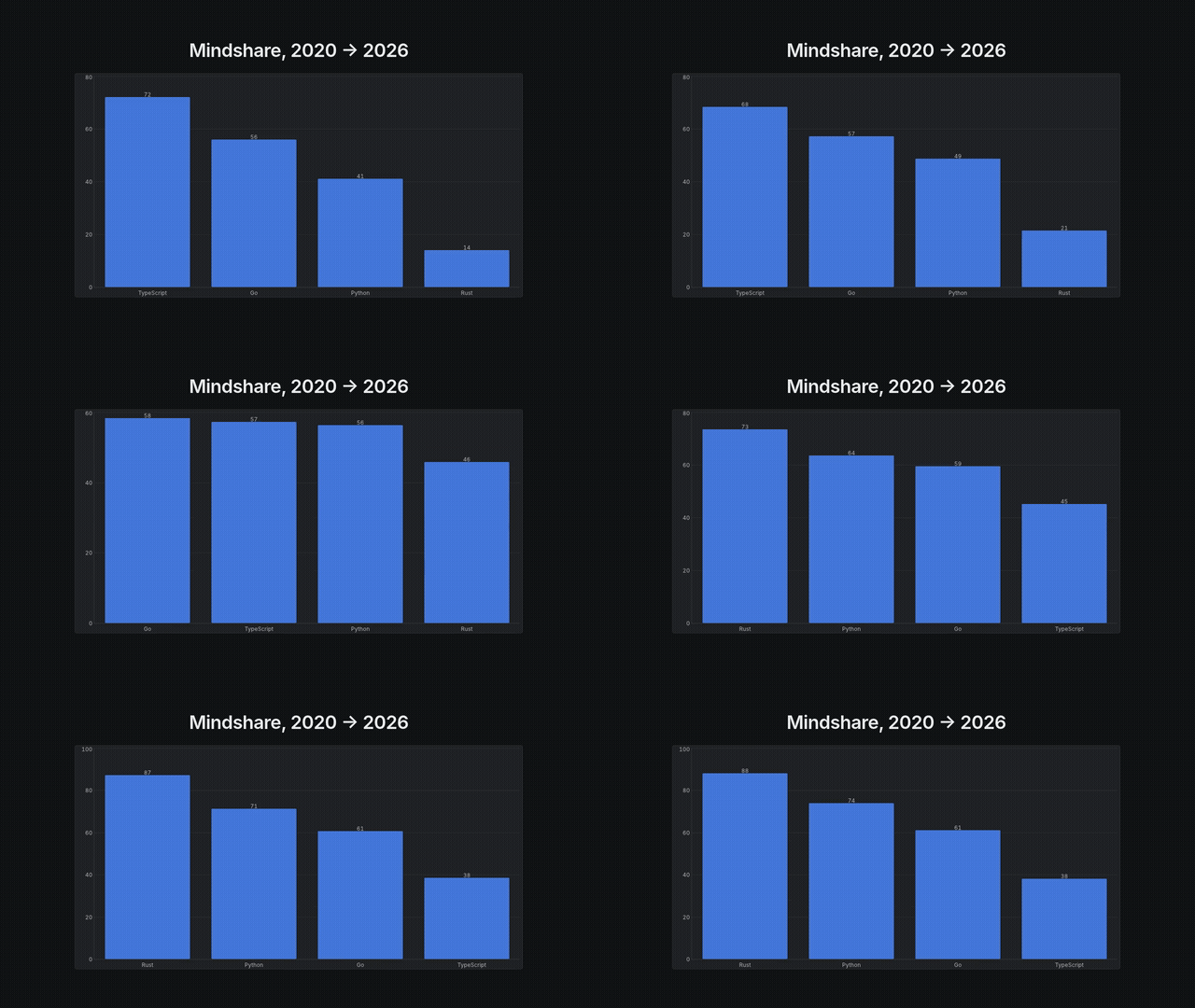
cargo run -p fenestra-motion --example chart_race -- --mp4 renders this
exact sequence — the lead changes hands partway through, verified
structurally in the example itself, not just eyeballed. Two more shipped
demos render the same way: a broadcast lower-third
(examples/lower_third.rs) and a per-word title stagger
(examples/title_stagger.rs).
Workspace
| Crate | Role |
|---|---|
fenestra |
Facade: prelude, run(), examples |
fenestra-core |
Element IR, theme/tokens, layout, text, paint, input, transitions |
fenestra-shell |
winit + wgpu window runner and the headless renderer |
fenestra-kit |
The themed widget kit, built only on core's public API |
fenestra-charts |
Sparklines, line and bar charts — the reference third-party widget crate |
fenestra-markdown |
CommonMark rendered as native fenestra elements |
fenestra-looks |
Six ready-made design languages (product, editorial, terminal, console, warm-editorial, playful), applied in one call |
fenestra-describe |
Parses fenestra/1 JSON into the same Element tree the builders produce |
fenestra-render |
The fenestra CLI: render, preview, film, query, verify, lint — from the command line |
fenestra-mcp |
MCP server exposing render, query, interact, and verify as thirteen tools to AI agents |
fenestra-motion |
Frame-pure motion graphics: timelines, headless frame/video rendering, temporal lints, the motion CLI |
fenestra-anim |
Keyframe animation math — easing, springs, an exact rational timebase |
fenestra-anim is versioned independently (0.1.x): a standalone leaf crate
with zero dependency on any fenestra crate, wgpu, vello, parley, taffy, or
winit, extracted from fenestra-core and fenestra-motion so any
frame/tick-based sampler — inside this workspace or out — can depend on the
animation math alone. fenestra-mcp is also versioned independently, so the
MCP server can ship on its own release cadence.
See ARCHITECTURE.md for how the pipeline, widget identity, transitions, and overlays work — recorded decision-by-decision as the framework was built — and BENCHMARKS.md for honest frame-cost numbers (a full screen rebuilds, lays out, and paints in ~0.3 ms; 100k-row lists virtualize to ~0.09 ms).
Design range
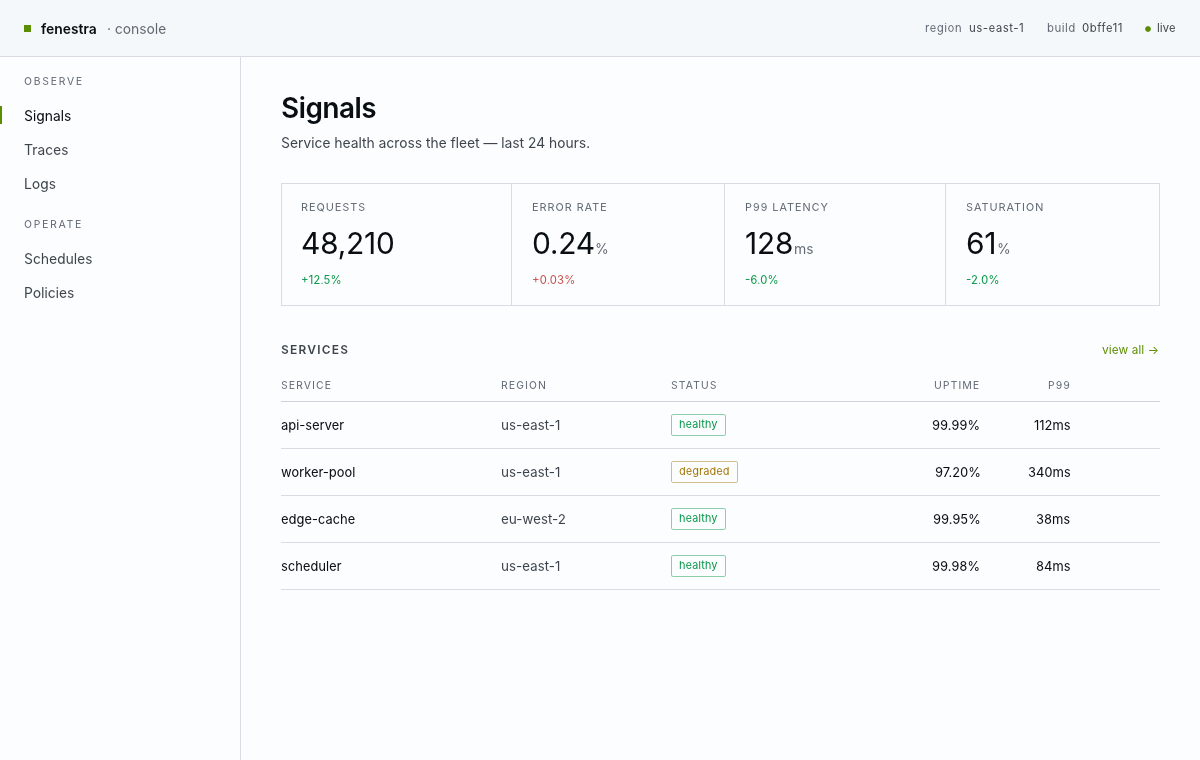
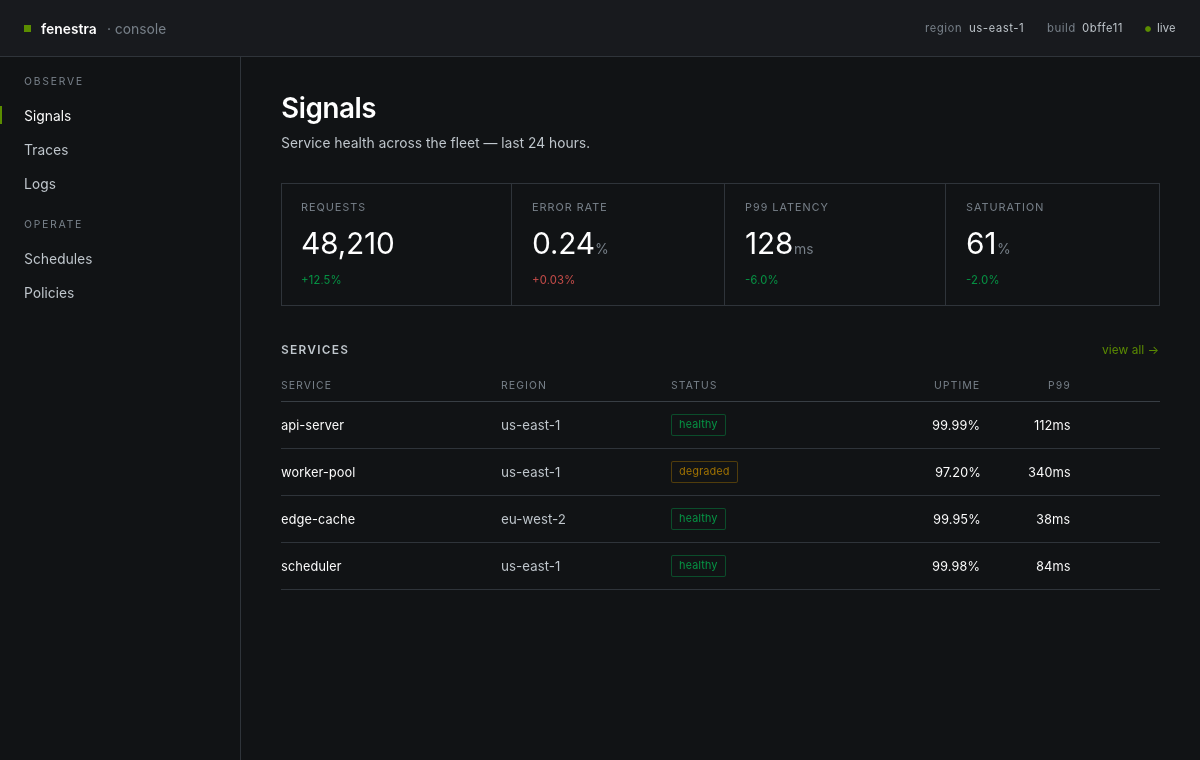
The same framework, the same tokens — a different design language. The
fenestra-looks crate bundles six ready voices (product, editorial, terminal,
console, warm-editorial, playful — enumerate them with all()), and one knob
re-skins the whole kit: Theme::with_radius(RadiusScale::sharp()) for
un-rounded tech chrome, Theme::with_elevation(Elevation::Flat) for
border-not-shadow surfaces, and Theme::duotone for atmospheric fields instead
of neutral grays (custom display faces register under font roles via
Fonts::register). The opposite end of the range from the soft default
dashboard above — a sharp, hairline-ruled console: slate with a single lime
accent and mono numerals, rendered headlessly and golden-tested.
| Light | Dark |
|---|---|
 |
 |
Composition, commands, accessibility
Components written around their own message type compose with
Element::map. Background work flows in through App::init, which hands
the app a cloneable Proxy<Msg> — spawn a thread, send messages, the
window repaints (examples/clock.rs, examples/toasts.rs). Every widget
exposes its role, state, and name: headlessly via Frame::access_tree()
(assert your UI is labeled, in CI), and to real assistive technology
through AccessKit in the windowed runner. Ambient motion comes from
looping Keyframes timelines; images from image_rgba8 (round avatars
via .rounded_full()).
Status
fenestra is at 0.40.0, built and recorded decision-by-decision in
ARCHITECTURE.md. Shipped: the full interactive widget kit
in light and dark themes; six ready-made design languages
(fenestra-looks); a frosted-glass material system; reference third-party
widget crates for charts and markdown; the fenestra/1 JSON format
authoring the entire kit, parsed by fenestra-describe and rendered/verified
by the fenestra CLI and the fenestra-mcp server's thirteen tools; a
live-reload fenestra preview window for authoring; and fenestra-motion
for frame-pure motion graphics with its own temporal-lint verification and
filmstrip capture. Every change goes through the same gate before it merges —
cargo fmt --check, clippy -D warnings, the full test suite, and a
headless golden-PNG comparison on macOS/Metal and Linux/lavapipe — plus a
weekly cargo audit sweep in CI. Open work is tracked as a ranked list in
ARCHITECTURE.md's "Deferred" notes; the two largest remaining gaps are a JSON
authoring bridge for charts/markdown (they're Rust-only today) and hi-DPI
headless rendering (every headless build site currently pins scale 1.0).
License
MIT or Apache-2.0, at your option. The embedded Inter font, the Playfair
Display faces (poster and editorial looks), the Fraunces variable text serif
(the opsz/optical-sizing serif in the warm-editorial look), and JetBrains
Mono (terminal look) are licensed under the SIL Open Font License 1.1; the
vendored Lucide icon path data is ISC (see fenestra-kit/LICENSE-LUCIDE.txt).
推荐服务器

Baidu Map
百度地图核心API现已全面兼容MCP协议,是国内首家兼容MCP协议的地图服务商。

Playwright MCP Server
一个模型上下文协议服务器,它使大型语言模型能够通过结构化的可访问性快照与网页进行交互,而无需视觉模型或屏幕截图。

Magic Component Platform (MCP)
一个由人工智能驱动的工具,可以从自然语言描述生成现代化的用户界面组件,并与流行的集成开发环境(IDE)集成,从而简化用户界面开发流程。

Audiense Insights MCP Server
通过模型上下文协议启用与 Audiense Insights 账户的交互,从而促进营销洞察和受众数据的提取和分析,包括人口统计信息、行为和影响者互动。

VeyraX
一个单一的 MCP 工具,连接你所有喜爱的工具:Gmail、日历以及其他 40 多个工具。

graphlit-mcp-server
模型上下文协议 (MCP) 服务器实现了 MCP 客户端与 Graphlit 服务之间的集成。 除了网络爬取之外,还可以将任何内容(从 Slack 到 Gmail 再到播客订阅源)导入到 Graphlit 项目中,然后从 MCP 客户端检索相关内容。

Kagi MCP Server
一个 MCP 服务器,集成了 Kagi 搜索功能和 Claude AI,使 Claude 能够在回答需要最新信息的问题时执行实时网络搜索。

e2b-mcp-server
使用 MCP 通过 e2b 运行代码。

Neon MCP Server
用于与 Neon 管理 API 和数据库交互的 MCP 服务器

Exa MCP Server
模型上下文协议(MCP)服务器允许像 Claude 这样的 AI 助手使用 Exa AI 搜索 API 进行网络搜索。这种设置允许 AI 模型以安全和受控的方式获取实时的网络信息。